Showing posts with label science fiction. Show all posts

Thursday, October 2, 2014

New Release: Different Dragons II

"Of the Generation" has been reprinted in WolfSinger Publication's Different Dragons II, a collection of cliche-busting dragon stories.

To celebrate the new release, WolfSinger is offering a 25% discount through Createspace-- follow the link and enter discount code TGERED9J at checkout. For those who prefer ebooks, the Smashwords coupon code ED26N will also give you a 25% discount at checkout. Both codes are valid only until October 15, so move quickly! 


Friday, September 19, 2014

The Ada Initiative and 'Citizen Editors'

It might be good for the world, though temporarily stressful for one’s marriage, to edit an anthology together, as Leonard and I discovered when we created and published our speculative fiction anthology Thoughtcrime Experiments together in 2009. Despite the risks, maybe you should become an editor. “Reader” and “writer” and “editor” are tags, not categories. If you love a subject, and you have some money and some time, you can haul under-appreciated work into wider discourse, curate it, and help it sing.  X
I appeared in Sumana Harihareswara’s Thoughtcrime Experiments anthology long before I ever thought of becoming an editor myself (in fact, the anthology was my first pro publication!), but her post today on the Ada Initiative and ideas for citizen editors* resounds even more with my added experience. While I'm not currently planning to publish a science fiction anthology, my work with self-published and indie authors has also made me think more about the responsibilities and potential of indie publishing. 
Harihareswara's post is rich with links to additional information for writers, editors, and fans, and closes with a call to support the Ada Initiative, a program to end harassment and make science fiction and technology communities a pleasure to participate in for all people. It's work that is incredibly important and tragically timely (to the point that I feel far more relieved that I should at not having attended many conventions this year, given the reports I've heard). I'm also reminded of one more initiative I’d like to boost visibility of: the BDG Editor-In-Training Program, which helps amplify the voices of editors who are queer and/or trans people of color by providing training and support in media and editing skills. In the words of Black Girl Dangerous, “Many of us who have the most to contribute to important conversations happening in indie media, including conversations on race, gender, queerness, economic injustice, disability justice, issues affecting youth, etc., have the least amount of access to the training, education and experience needed to be successful in contributing to and leading independent media movements.” 
Sometimes I’m brought up as an example of diversity in sci fi, for my gender, and while I appreciate people being excited for my inclusion (especially given all-too-recent incidents when no women at all were appearing in certain big genre anthologies**) it’s very important to remember I’m a cis, white woman—my challenges are minimal compared to many. 
This post is also fascinating in that I’ve learned today that not only do I share a table of contents with Hugo, Nebula, and World Fantasy Award-winning author Ken Liu (I knew that—I’ve been a low-level but genuine fan since reading ‘Single Bit Error’ in my own copy of Thoughtcrime Experiments), but that he credits his career to the publication that put us on that table of contents! 
*’citizen editor’ is a term I just made up without reference to any external source while trying to concisely compact the ideas of Harihareswara’s idea-rich post—like ‘citizen science’ but perhaps without the hierarchy. Citizen scientists are, after all, still limited by the technology and knowledge they have access to, making them helpful but in somewhat narrow roles of data collection and simple analysis. Citizen editors aren’t limited in that way at all. If you have some knowledge of how writers & writing work, and can figure out how to use Kindle and a POD printer, you have the primary resources to become a citizen editor all the way from acquisition of manuscripts through publishing and publicity.

**I don't think most people visiting my blog are interested in playing devil's advocate, but to make my point very clear, I do not claim that I specifically would be entitled to appear in any of those anthologies, especially not at that (very very early) point in my career. Women were robbed of a position on Mindblowing SF's TOC (and others), but I would not consider myself one of them. All the same, being a young writer at the time, I wasn't precisely discouraged, but was certainly frustrated to see that gender, along with race (if not in any way as straightforward as mustache-twirling misogyny and racism, through good-ol'-boys-club networking and perhaps simple myopia), was a thing that could count against people like me and writers I admired, even in the highest ranks of the field. Part of the reason I wasn't truly discouraged was that such discrimination felt more rarely encountered among the indie publications I still mostly publish with. Which I think goes to support Harihareswara's point. 

Monday, May 26, 2014

"The Witch Hunter's Account" in Nameless Magazine

Nameless Digest Issue #3 contains, among many other fine stories, my "Witch Hunter's Account."

Like "The Astrologer's Telling," published in Daily Science Fiction last month, "The Witch Hunter's Account" was inspired by one of Lovecraft's favorite authors, Arthur Machen, and is also a response to Lovecraftian cosmic horror, again with fewer tentacles and, I like to think, less xenophobia than Lovecraft. Hmm, actually, scratch that bit on the xenophobia (although I'm sure a conversation could get started on the refugee themes in "Astrologer's Telling." It may not have been a conscious screw-you to Lovecraft's intolerance, but I'd be tickled if people read it as such). No, Witch Hunters aren't exactly known for their open-armed acceptance of difference.

In "Harmony," a story published in Kaleidotrope Issue #8 some years back, I made my first attempt to hash out a dichotomy or Harmony/Discord--not good/evil or order/chaos, but rather permissive-of-life-as-we-know-it/utterly-inimical. It's not that Discord is objectively bad (there is no objectivity), it's just...very easily made uncomfortable for us squishy organic lifeforms. But even here it's not a clean cut. Because sometimes we want the rules of the universe to work differently, at least for a short while. A lot of the themes in "Harmony"--including the seductiveness of Discord and the "they who hunt monsters" elements hinted at beneath the surface--are further developed & examined in "The Witch Hunter's Account." Plus I got the chance to develop the culture of colonized, terraformed 31st century Mars, a place I certainly hope to return to with later stories.

An excerpt from "The Witch Hunter's Account":

Just before dawn—the dossier said she was an early riser—I drove up the cliff-hugging pink gravel road. The gates opened at my name although I knew I wasn't expected, and I parked in a courtyard shaded by some of the most luxurious growth I had seen on Mars. A housekeeper, dressed in smart black, was passing a sprinkler over a bed of poppies in the shade of a vast palm.     
"Go right in, Mr. Saye," she said. "The gate announced you. Ms Mao will see you in her study, right at the end of the hall."     
The inside of the house was as comfortable and modest as the exterior, though again overgrown by plants spilling from urns and troughs set before windows, on tables, and even directly on the plush burgundy carpet, staining it with water around their bases. The hall was permeated with an unnerving feeling of good health. I hurried to the door at the end of it, and it swung open at my touch. Also unnerving, the way every door and gate seemed to yield to me.    
 The study wall opposite the door was taken up by a vast window overlooking the sea. A pale Martian sunrise polished the waves, and it was a moment before I looked away from the sight to see the woman standing at a narrow bookcase.     
"Ms Mao?" I said.     
She turned to me, sliding a book back onto the shelf. Theophania Mao had a slender body and a round face, unlined save for softening wrinkles at the corners of her dark eyes. Her hair, onyx-black, hung to her chin in a style graceful in its plainness. Her long red dress was tailored in the fashion of a business suit.     
"Mr. Saye," she said, "would you like to sit down? And you would mind if I called you Jonathan?"     
Of course, she must have thought I was a client. A patient, I corrected myself—the file Edith Zann sent me said she didn't charge for her miracles.     
But she did call them "miracles." I took a seat with my back to the window.     
She pulled up a chair and sat across from me. "Can I get anything for you? Coffee? Wine? A glass of water?"    
 "No, thank you." I realized I still wore my hat and removed it, with a nod of apology, wondering what about this case was making me so nervous.    
 "Are you certain?"    
 She asked with such insistence that I said, "Water would be fine, thank you."     
She buzzed the order into her intercom with a small smile. The knotting in my gut unraveled, then rewound itself, as I considered her. She plainly enjoyed offering a helping hand, if only by offering refreshment to a stranger at her door. She had a generous spirit, the air of a person born for service. It disarmed me—while I knew some fell into Discord for noble reasons, it was academic knowledge; the only crusaders I had met were like Zann, on our side.    
 "I have something to ask you, Ms Mao," I said.     
She bent forward in her chair. "Yes?"     
"I want to know how you do your healing."     
Her eyes lowered, and she sat back like a reprimanded child. Her voice was firm but also apologetic as she said, "I can't teach you how to do it."     
I shook my head. "I don't need to know for myself, ma'am. I'm curious about your own method."    
 Her eyes narrowed. Anyone who might have taken her eagerness to help as a sign of weakness—or naïveté—would have been corrected by that look. "Why?"    
 "I have some interest in science," I said. "I'm slowly forming a theory of how things perceived as miraculous—like your healing or Miguel Chapman's levitation and walking on water—"  
 "Miguel Chapman's performances," she said, "are all charlatanism."       
"I'm not so sure, ma'am. Either way, I'd like to see examples of your work, and try to fit it into established science."

Saturday, April 26, 2014

"The Astrologer's Telling" up at Daily Science Fiction

...charnel winds that brush the pallid stars and make them flicker low.

Ever since I first encountered that nightmare image, from H.P. Lovecraft's prose-poem "Nyarlathotep," I have wanted to write a story about the stars going out. A morbid urge? Absolutely. But there's a certain virtue in morbidity; it makes me thoughtful and perhaps compassionate, if that's a thing a writer of apocalyptic fiction can be.

And so "The Astrologer's Telling" comes from a different philosophy than Lovecraft's more nihilistic landscape.I hope it proves, as well as terrifying and mournful, perhaps a little inspiring. I spent some time worrying about the science of kindling and extinguishing stars, before I at last embraced the fact that my interest was much less scientific than artistic and emotional. And I hope the story is more impactful for it.

About this time last year, this story received an Honorable Mentions in the Dell Magazines Award for Undergraduate Excellence in Science Fiction and Fantasy Writing (whew! I've never been able to write the full name without looking it up). I am very grateful to Rick Wilbur and Sheila Williams for constructive commentary after the contest.

Monday, February 24, 2014

Veterans of Future Wars release

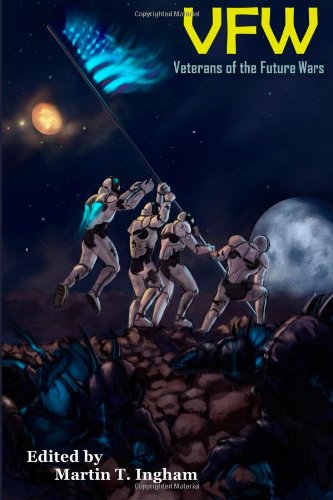
My short story "Ayema's Fleet" has been reprinted in the Veterans of Future Wars anthology from Martinus Publishing. As with the Battlespace anthology "Ayema's Fleet" first appeared in, VFW is for a good cause--10% of proceeds from the anthology go to Disabled American Veterans.


I've done an interview with anthology editor Martin T. Ingham, which can be read here. And the anthology itself is available in print and ebook at Amazon.com and Barnes & Noble.


Wednesday, November 6, 2013

Review: Serving Time by Nadine Ducca

For this review, another thank you is in order to the LibraryThing giveaways program, and of course Nadine Ducca herself for offering the first volume of her Timekeepers trilogy. I'm a winner once again!

18598175


Although I was often confused over what was going on, the original mythological background  of Serving Time was strong from the beginning. The author has clearly spent time developing this mythology and shows it by demonstrating her characters' familiarity with its workings. I found Robert, the wizard who figured out how to blackmail Time, a fascinating character. He didn't play a major part until the end, though, as there is a wide cast of characters scattered across multiple planets, satellites, and outposts. And as for the story's mythology, it's far from comforting. After the Angels meant to guide souls through their many incarnations have fled, the demonic powers, kept barely in line by a frazzled Time, try to pick up the task. Nobody is particularly happy about this. Not Time, who has her own concerns. Nor the demons, who are meant to devour souls, not look after them! And who must contend with the ever-present threat of clerical work.

Things are no more comfortable on the mortal plane, where big businesses now run pretty much everything with no sense of corporate social responsibility. It forms an interesting parallel with the bureaucracy on the mythological plane. Our protagonist's Tristan's opening scene, which shows a day in his life as a hired assassin dogged by robots ready to clean up after his "job," was pulpy goodness worthy of Blade Runner, or perhaps The Fifth Element.

The demands of being a killer for hire have driven Tristan to a breakdown, making him less than useful to his bosses, who sell his contract cheap to another corporation even more lacking in concern for employee welfare. Meanwhile, Tristan's brother Eneld is visited by a demon who gives him a warning: it's his task to look after his brother's soul in this, Tristan's final incarnation before he's damned to the Respository (hell in this setting) as damaged metaphysical goods. Although the brothers may be less than convinced by this vision, they clearly have pressing problems as Tristan is pursued by his new bosses, who he's trying to escape.

The prose and tone of the story varies widely. I admit I have nitpicks--like when the Goddess Time is described as a "fifteen foot" colossus on a limitless plain. The exact number makes her size ever so slightly less impressive (I like to think most mortals won't whip out a yardstick on their first confrontation with a deity). But the dialogue is plausible and mostly snappy. There are also points where the prose becomes playfully visible-"It was on the verge of hyperventilating, if soul dew could ventilate in any way." Fun and fitting with the bizarro tone. And yet in other cases I just couldn't figure out where the author was coming from. What does it mean that Time has strands of hair "like honeyed spiderwebs"? And another thing that puzzles me, and makes me wonder how seriously the science-fiction worldbuilding is being taken: why is Tristan's drug run for his corporate overlords done under cover of an interplanetary shipment of tiramisu? Glad as I am to know we'll still be eating tiramisu centuries from now, wouldn't it be a thousand times faster and cheaper to bake it on-planet? Did nobody find this sort of suspicious?

Speaking of baked goods in the future, fruitcake and Christmas are still going strong, even as the Sagrada Familia cathedral in Barcelona has not only been completed but also fallen into ruin again (I see what Ducca did there, and it amuses me, not least because of the sense of scale it gives). All the homey anachronisms could probably be excused in the end, although I always like to see spec fic writers dream a little weirder. But the tone never quite recovered from the revelation that the highly laid-back population of the Stone Cloud spaceship call themselves "Stoners". I love puns from the likes of Peirs Anthony, but I felt rather offended on behalf of my sense of humor at that one (reminds me of cowboy romance talent Diana Palmer's first venture into sci-fi, where she thought she'd be clever by having the alien race of the Centauri system be named the Cehn-Tahr*). How much danger in Tristan's soul really in, and how much should I fear for him, in a world built with puns?

Puns aside, a sort of wordplay does go into the mythology-building of this story too, at least for fans of Madeline L'Engle. Over the ages, Time has developed quite a few wrinkles, and is displeased twice over when various galactic species start exploiting them for time travel--plus the apparently unforgiveable indignity of being a female deity who does not look like a teenager. I mean, Lucifer certainly isn't worried about his looks. Then again, Lucifer doesn't have the problem of being a gorgeous young woman everyone pictures as a white-bearded Father, so I guess I can cut Time some slack here. Mythological figures being irritated by mortals' mistaken impressions of them is a trope I usually enjoy, but I enjoy them because of the surprise factor; a female character being caught up in her looks is, alas, not much of a surprise. In any event, Time's vanity is assuaged by Robert's offer of a cure, in exchange for perks like power and immortality. But Time has another favorite human: Tristan, who in a past life was Time's good friend Alexia. Perhaps I only dreamed the lesbian subtext between those two, but they were certainly very close--Alexia medicated Time's vanity just as Robert does in the present, but they also went on adventures together literally to hell and back. The sweet girlfriendship plot, and Time's tendency to call Tristan "Alexia" even when he's romancing her, redeemed the otherwise disappointing representation of female characters. I warmed to Eneld only very slowly after his intro shows him in bed with a woman who he calls a slut (granted, logical thinking is never his strong point, but why is this supposed to be attractive in the character who serves as the moral center? Tristan's much more screwed up, in that he actually kills people for a living, but he's very upfront and equal-opportunity in his screwedupness). Jim Kirk spoiled me; I expect the 23rd century to be a touch more progressive, to say nothing of free love.

This story ends on a definite cliffhanger, but its resolution centers more around Robert than Tristan in my mind. This is fine, except Tristan has been the more central character, and winds up nothing but a pawn for the last chapters. His story will be continued in the sequels (Serving Time is the first of the Timekeepers Trilogy). Overall, while this story has an entertaining setup and I appreciate the devil-may-care attitude blending mythology and gritty science fiction, the sometimes corny tone and lackluster character development made it hard to lose myself in. Readers more used to irreverence in their stories (use the "Stoners" pun as a guideline) might even love it. 

Links:
Goodreads
Amazon
iTunes
Kobo
Barnes and Noble

*I discovered the MST3K-style running commentary I made for the first few chapters of Palmer's Morcai Battalion, and if you think I'm snarky now, you should have seen me then. Although since I've become a writer myself I try to nicer to my fellows, I think I was also being defensive of my genre. Nobody's an interloper in sci-fi, I don't want to be a gatekeeper, but neither do I like to see such careless writing. It gives the impression Palmer thinks all sci-fi writers are so careless, or that her publisher thinks all sci-fi readers are heedless of the quality of their reading material. Even as a teenager I was eager to prove them wrong.  

Sunday, September 15, 2013

Story up at Perihelion! "Equations in the Mirror"

My science fiction story "Equations in the Mirror" is up at Perihelion Science Fiction. This is one of the few stories that ever required me to whip out a calculator (another is Ayema's Fleet in the Battlespace Military Science Fiction anthology) and was based on a number of cool medical techniques I'd learned about. Being for a time a Paleolithic history/pre-history fan, I was delighted to learn that obsidian stone blades are still used by surgeons in the modern day. The idea of dark glass and dark reflections tied in with other, more unsettling medical advances in cosmetic surgery.

That math I did involved taking measurements of my own face (actually just one measurement: I think of the length of my lower eyelid) and then extrapolating the other numbers according to the supposed ratios of the Golden Equation as applied to the human face. You may roll your eyes (which are the perfect length, if I may say) or raise your eyebrows (wonderfully proportioned--not to be creepy), but for what it's worth, some cosmetic surgeons do claim their work has a basis in the Golden Ratio. Which is why I was more amused than stung my one of the rejection letters I've preciously received for "Equations," one that said The concept of basing cosmetic surgery on the Golden Ratio just didn't ring true...at all.

Monday, September 2, 2013

September Publications: Scigentasy and Voluted Tales

Happy Labor Day to those of you celebrating it! I'm at this moment not quite employed enough to, but I do have some exciting writing announcements.

First, Silver Chests and Plain Sight has been reprinted at Voluted Tales. Half-detective story, it may have been influenced by Peter Tremayne's delightful medieval monastic mysteries--although my cleric happens to be female. 

I also have an original story publication: A Marriage, Pure and Good is at the new Intersectional Feminist webzine Scigentasy. I've been excited about Scigentasy ever since it opened its...doors? webpages?...anyway, point stands, I am thrilled beyond belief to actually be featured in it! A Marriage also sits pretty close to my heart, being one of the first stories I wrote featuring LGBTQA themes. Particularly G and A--the protagonist is an aromantic asexual woman. There really aren't enough aro ace characters out there, so I'm excited to add to their numbers, and grateful that Scigentasy is giving me the opportunity. 

I've been featured in a lot of feminist speculative fiction publications, both recently and in the past--Scigentasy, Daughters of Icarus, The Future Fire, Warrior Wisewoman and Sword and Sorceress, and I have two reprint stories forthcoming from the new anthology series Andromeda's Offspring. Each time I approach the themes of gender, sex, choice, pacifism (nonviolence is not always tied to feminism but it is intimately tied to my own stance), identity, and relationships from a different angle. I don't always agree with myself, either! Much less with every character--although allowing them freedom of choice and identity is what lets me write fiction in the first place. I have no all-encompassing summary statement, much less a great insightful truth, to close these musings with, so instead I'll just say--I hope you enjoy reading these stories and thinking about these questions as much as I enjoyed thinking about these questions and writing these stories! 

Friday, July 26, 2013

Reward in Daily Science Fiction's Kickstarter! Also, Newsletters.

Daily Science Fiction is hosting a Kickstarter Campaign to pay authors for their short fiction published for the next six months, September 2013-March 2014.

Among rewards including omnibus anthologies, gourmet chocolate, and a crocheted Cthulhu, you can also sign up for a critique from Yours Truly of a short story (they say up to 5,000 words, but I wouldn't complain about longer, either)! See the details for Daily Science Fiction's Fall 2013 campaign here.

On the topic of Kickstarter campaigns and critiques, the campaign for the Starter Guide for Professional Writers has breezed past its original goal--made it more than 4x over, in fact--and is just $130 shy of the Stretch Goal. If the campaign raises $1,000, I'll have enough financial leeway to offer a half-off deal on any manuscript critiques to all my Kickstarter funders. There's a little less than a week yet to get it on that.

A last piece of news: if you check out my 'Contact' page on the right sidebar, you'll now see an embedded MailChimp form allowing you to sign up for email alerts on the publication of my short stories, books, or just life in general.

Plans for the weekend: Well, I've spent the past week touring subleases in DC, and there are one or two I really like and am following up on. Fingers crossed! And then it's on to the job search in August and September!

Sunday, May 26, 2013

WisCon 37--A Partial Review

I was certain I wouldn't make it to WisCon this year, coming as it did right before my moving trip to Washington, D.C. But with some last-minute crunch and a willingness to run around disoriented (I've learned these will get you far in life, or at least lead me very far afield), I made it for at least the weekend and Friday evening.

Friday:
After hurriedly packing for DC, I stuffed my backpack with my immediate needs for one weekend and set out to brave the Memorial Day weekend traffic. And then Madison's one-way streets. This harrowing experience concluded in time for me to make it to dinner with my sister and some lovely strangers she met on the Internet. Between weekend festivities and the convention, every restaurant in central Madison was packed. Still, the 45 minutes before harried waitresses brought our food gave us time to go through our pocket pamphlets and circle likely-looking panels. This process is one of anticipation mixed with frustration--there's always 2 or 3 different panels going on at the same time that I want to see. And there's a limit to how much running around disoriented even I can do.

The first after-dinner panel we attended was "Cyborg Identities," a discussion of Donna Haraway's theory that cyborgs transcend science fiction and have potential for feminism and social theory--given the omnipresence of technology and constructed reality means that we are all cyborgs. I'm paraphrasing from what I gathered, as I haven't actually read Haraway (Megan, the grad student, made our panel decision there ;D). Still, it left me with some take-away thoughts on how reality is constructed--"there's no such thing as nature," if nature means a state where humans do not alter our environment through our interactions with it--and a glimmer of understanding about polyrythms as the panel was lead in an impromptu performance by panelist Andrea Hairston. I am not particularly good at managing even a monorythm, but it was interesting to know more complex patterns are possible.

We dropped by the QUILTBAG TARDIS party, but turned in early after a long day. Megan wanted to prepare for her reading and to be a panelist on Saturday, and I saw a morning panel that looked appealing.


Saturday
Woke up bright and early, hoping I could get lunch before the panel on 'Digital Death' that I dearly wanted to attend. I was in luck, as right outside the hotel doors I discovered a farmer's market, including multiple booths selling bakery items. Cinnamon raisin bagels provided me with nourishment to face the next few panels.

Digital death: Worrying about the privacy of your online information while you're alive is bad enough, but what do you do when you die? Who inherits your ebooks? How technologically savvy does your digital executor need to be? Are you better off just waiting for a grad student of the future to crack the encryption on your hard drive (much joking about what that student may find there--including disappointment that it's only 2D), or perhaps creating a "dead man's switch" to automatically revert your password to 'password1234' when you, presumably dead, fail to log in after a year? Takeaways to remember: Katherine Mankiller's story of the parents of a friend whose discovered, upon that friend's untimely death, the slash fanfiction on her LiveJournal (they made peace with that side of her, prompting the slogan "We love our dead slash-writing daughter!"); the importance of periodically reviewing your will and any listing you have of active accounts and passwords; the impact of changes in format ("Plain text is your friend," and maybe pdf if it's kept simple), and "loooove your data". Also sue people if you really want to do a favor to your future family genealogists; it's a great way to get your information recorded and preserved.

Women in Power: This one seemed to fly by far too quickly, before the panelists could really sink their teeth into issues like "what is our working definition of power?" and "Do we recognize power when it's coming from someone other than the recognized head of a community or association?" We did learn about a number of remarkable historical and modern women, from Wu Zetian (first female emperor of China) to a modern Chinese scientist who single-handedly fought an AIDS epidemic in her province. Also discussed was the importance of media attention, documentation, and the use of awards and public recognition to turn the personal power of an individual into the communal power of a movement.

I met up with Megan after the morning panels to grab lunch in the con suite (the sweet onion relish, which must come from a local Wisconsin farmer or his/her grandmother, is to die for; and for some reason all the LonCon fortune cookies we opened recommended stores by Iain M. Banks) and explored the dealers room and art show. Despite being too broke to buy much of anything--except a copy of Dr. Who Magazine with Paul McGann on the cover, modeling the Eighth Doctor's new black leather peacoat look--I made grabby hands and high-pitched yearning noises at books, jewelry, paintings, felt creatures, and a miniature clay figurine of Jon Snow and his white wolf puppy. I haven't even read the books or watched Game of Thrones.

Editing for Writers--this after-lunch panel was packed, probably to the joy of panelists who remarked "There is not enough good editing going on." Being almost obsessive in my pursuit of melodious prose, I can only agree. However, the main problems are less stylistic than failures of clarity--or, as one panelist put it, "Is this clear? And is this funny to anybody but you?". Thus the importance of beta readers and professional editors, and the importance of listening to and communicating with your editor. However, the main flaw of beginning editors (and betas!) is tactlessness--being too blunt about the failures of a text. Sadly, I can testify to the truth of that myself (I and my friends have gotten way better since the first meeting of our high school writing club). Another observation true in my experience is that many new writers develop bad habits as a result of lax schooling--basically, teachers are so happy to find students who enjoy writing and have a grasp of grammar and structure that they never push us to try better. But again, that's what editors are for.

I attended this panel for more than one reason, given my freelance editing jobs. It was not exactly encouraging to hear one woman ask for advice on becoming an editor only to be pressed to keep writing instead--"You can make it rich writing!" Then again, these are also editorial positions that include wading through slush piles, which I have only heard horror stories about. Panelists did mention that developmental edits can be particularly useful for writers who have what they feel is a solid manuscript which keeps getting rejections for no reason they can discern. Developmental edits and copy edits are both essential for authors considering self-publishing--otherwise, the publisher will supply a copy edit. Sometimes a copy edit from Hell where all the flavorful local dialect your characters utter is corrected, but that's why communication is important! Personally, I think it's also appropriate to hire an editor when you have a manuscript which needs attention that beta readers can't give it (either because you can't find a beta in your genre, or want something more in-depth than most volunteers can offer) before being submitted for publication.

It's Actually Quite Hard to Rip a Bodice Part 2: The panel on historical accuracy in fiction was as much of a riot as it was last year! Refreshingly, there was a greater range of panelists this year--guest of honor Jo Walton said her method of research was less directed than "suddenly writes something and realizes random recreational reading of the past decade was leading up to it", which sounds more my style than "50% background research before story, 10% during, 40% after" because with my luck the 40% after will be what proves everything I wrote could not possibly have happened (in this world, at least). I'm more likely to look at real-world historical research for inspiration than to let it tell me what I can or can't do (*stops foot like petulant teenager, shakes fist at History*). All the same, I'm perfectly happy to hear what people who do research exhaustively write and discover. Discoveries include things as weird as the "Swiss army knives" carried by the Roman legions, and the fact that ancient Greeks and others told the future by examining the liver because they believe the liver is the seat of the mind. "Because it's triangular," Walton assured us. This somehow led to her wondering whether they ever told the future by the placenta (apparently you have to have seen one to get this; I have not and will take it on faith). They never did, so she can write that original idea into a story sometime...the payoff for intensive research, I guess.
Oh, and they've tried ripping bodices. From what I remember from the panel last year, bodices are sewn together in a way that resists tearing quite remarkably. Sorry.

Help, Gender Essentialism Is Everywhere!: I attended this panel on how writers can avoid gender essentialism to give support to my first-time panelist sister, missing out on a discussion of Large House vs Small Press vs Self-Publishing and, perhaps even more distressing, "Realistic and Unrealistic Sex in Fiction."
I jest.
Well, a little.
I did attend to provide moral support, but this was an intensely interesting panel that I would gladly have attended anyway (even to the point of missing out the other two? Well, that's what the internet's for! By which I mean the Absolute Write Water Cooler forum has plenty of discussion of publishing options--what did you think I meant?). The panelists discussed their own efforts to include sexualities outside the gender binary, what methods were successful, and what happens when reviewers get confused. Luckily, there seems to be a healthy number of short fiction markets that are enthusiastic about representing non-binary identities, though this may be more difficult in longer works with New York houses--none of us are exactly sure. My question about managing and countering stereotypes for characters who lie on multiple identities prompted one of my favorite quotes of the convention, from Keffy R.M. Kehrli: "Be careful when playing at intersections; you may get hit by a truck!" By which he meant not that it isn't worth doing, just that it needs to be done sensitively and with care. The air of the panel was overall encouraging: representing non-binary and/or trans* characters isn't to be done lightly, but it's also done far too rarely and many editors and readers are eager and supportive of writers willing to try.

After grabbing dinner (and an ARC of Sam Sykes' The Skybound Sea, which I was literally unable to put down--I tried, but blasphemous monstrosities were rising from the ocean and the prose sang in my ears), Megan and I grabbed seats somewhat in view of the stage for the Tiptree Auction. Last year we were on the far side of the ballroom, but really, wherever you're sitting the auction is as good or better than a night with the stand up comedian of your choice. From the opening bids on a paperback copy of the 1971 classic The Feminists--our sacred text went for almost $50; not bad considering I think the cover said 35 cents--to an Alice Sheldon pillow, decorated rocket ship tiles, original Lynda Berry illustrations, more pulp paperbacks featuring buxom 'hoydens' and sheer pastel spacesuits (I'd have bid on A Woman in Space but it was already over $30, which given my budget seemed a bit much even for such a juicy morsel), a Space Babe engraved hip flask, a robot-decorated bag featuring the damn cutest baby robot ever, and the shirt off Ellen Klages' back. Also an Ellen Klages doll, which I'm sure we never knew we needed before. And a bottle of Lysol, which I'm sure was never ever never needed for its advertised purpose. Why we need feminism, indeed (well, that and in order to round up all the men for breeding chattel. I read it in a paperback, it must be true).

We popped out of the auction long enough to see Lauren Jankowski read from her first novel, Sere from the Green, at the Broad Universe reading, but then we came back because we were having just too much fun. We left once the auction started winding down.

Sunday
No farmer's market, but I did have to jog across the Madison Memorial Day Marathon to get to the Concourse. Not quite certain what to do, I stood on the curb and applauded runners approaching the finish line until I saw a clear space.

Another early morning panel for me, this one on "Intimate vs Remote Gods". Panelists ran the gamut from a Lutheran minister to a content atheist, so lots of interesting discussion made it worthwhile. Also one of the panelists recommended C.S. Friedman's Coldfire Trilogy, and I savor the proof that I am not the only human being to read and enjoy it (logically the fansites and fanfiction suggest I'm not, but I never run into fellow fans in-person). I also need to check out the Dark Faith anthologies, which kept providing intriguing examples.

Race and Class in Urban Planning--though the topic has some applicability to science fiction and fantasy, this panel was mostly about real life: school closures in Chicago, "affordable housing" in San Francisco, gentrification everywhere and enough hipster artists and "urban pioneers" to make you want to call pest control. By which I mean hipster urban pioneers were discussed; if any actually attended the panel they kept it well hidden (wisely). Audible dismay passed through the room when we learned that classrooms in Chicago public schools are considered "underutilized" if they contain less than 32 students. My parochial school class was treated as unmanageable in the second grade for having 31 kids. Which wasn't inaccurate. Developers still only pay lip service to consulting communities before going ahead with projects that can destroy neighborhoods--except when they run into committed citizens ("granny power" as one panelist described what happens when the retired and unemployed in a community go to work lobbying for its interests) who can command media attention. This is the sort of fascinating conflict that should be appearing more in fiction.

Megan and I compared notes and realized we each technically meet the threshold for the Mid-Career Writers lunch roundtable: we've both been publishing short fiction since 2008 or earlier. In any event, we didn't get thrown out. New writers have a lot of resources to draw on, which is great, but what happens for the rest of your professional life? A group of eight or nine of us introduced ourselves, described what was going on and particular challenges faced at this point in our careers, and brainstormed solutions. This is the sort of meeting I'd like to attend more often, although still being on the very new end of the mid-career I spent most of the time listening.

My last event of the day was the Outer Alliance Reading, with Megan along with 6 other writers reading excerpts, short stories, and poetry. I don't usually read Megan's fiction for some reason, maybe lack of time or the feeling that I'll be asked to beta for her again one day (I don't think I'm afraid of being influenced by her; our styles have gone in very different directions), but ohh boy, I had goosebumps at her reading. Other stories were more lighthearted. Especially fun were Cliff Winnig's "The Call of the Sky" (in When the Hero Comes Home 2), with clone families and ensuing identity crises that were just complicated enough to be refreshing rather than confusing, and Sunny Moraine's snappy, elderly seer confronting the wastrel playboy of her space-nomadic tribe in Line and Orbit. In my post on using bookmarks for promotion I mentioned that they are useful more as a reference for individual readers than as a sales tool, but Moraine made good use of them for both--I grabbed one after her reading convinced me her story is something I'd really enjoy.

I drove home after the OA reading, to finish packing and get some rest before setting out tomorrow. This is my last blog post from Wisconsin in who knows how long. At least you can be a fantasy fan & writer from anywhere!

Wednesday, April 10, 2013

Daughters of Icarus released!

One of the exciting things I was away from (doing even more exciting things, so I can't be too sorry) was the release of Pink Narcissus Press's feminist science fiction anthology, Daughters of Icarus. This collection of stories exploring future possibilities of sex and gender includes my piece, "Two Rivers".

As ForeWord Reviews has it:
In “Two Rivers,” by Therese Arkenberg, researchers travel to a planet to study people whose unusual characteristics include a third gender and a complicated hierarchy. The narrator struggles with how the researchers’ interactions with the individuals they are studying, starting with their first diplomatic outreach, play a role in a growing and serious conflict between the planet’s civilizations. That thoughtful conflict and Arkenberg’s rendering of a strange-but-familiar world make this story stand out.

Daughters of Icarus is available in ebook and paperback from Amazon, Barnes & Noble, and the Pink Narcissus Press catalog.

Sunday, February 10, 2013

Added: Publications List

If you look to the right of this post, you can now see a link to my Publications List, probably the single most useful page on this blog. It offers links to my stories, roughly organized by length and genre and also by series. There are currently 3 of the latter in progress:

A Dark and Wonderful History: Stories of Women and Monsters, is a sort of parallel history in a secondary world that has a share of similarities to our own. Also its share of differences. Gods, ghosts, the shapeshifting and blood-drinking Dihneen, sacred and magical trees, and doors that open to unimaginable places appear in these stories, all encountered--and sometimes, if only for a short time, controlled--by women.

The Curse-Strewn World is a planned series of at least five short stories and one novelette. Currently the first story--not the first chronologically, but written as a bit of an introduction--is available in Beneath Ceaseless Skies' 110th issue. "The Storms in Arisbat" was originally written as a sort of personal exorcism. I hoped if I could get down at least one story featuring these characters and their journey, which kept haunting me, I could move on with other projects (of which, like many writers, I always have too many). Well, I did complete the story, and some readers and reviewers enjoyed it--they enjoyed it so much that, like Lois Tilton in her Locus Online review, they wondered if there were more stories to come. The answer is: Yes. Yes, there are.

Heart's Kindred, featuring the swordsman Rathin and the wizard Anweth, I've written to be a purely enjoyable adventure series. As more stories are completed, they'll continue to build up the world where the wandering couple lives--a world which is linked, in fact, to several other stories I've written (read Of the Generation, based in the same setting, and you'll discover at least one custom, or perhaps a sort of spiritual or lifestyle practice, that also appears in Aqua Vitae). These links are far from unusual, and even my unsorted science fiction and fantasy stories may share references with each other. There's a scavenger hunt, or perhaps a bingo board or a drinking game, in there somewhere.

It's also for reason of shared setting that I've grouped the stories taking place in and around the Xeocin empire, though they are not by any means a series. The world-spanning empire's capital city of Xeocib is the locale of the novel I'm currently writing (reviews of The Halcyon in Flight especially have stated that there seems to be more background to the story than is shown, and probably further stories as well. They're right). While these short stories will not by any means be necessary to understanding the novel's plot or characterization, I think every single one of them has been referenced in the current draft of the manuscript.

As I created this Listing, I discovered a lot of 'dead links' and the reality of several stories which are no longer available online, in print, or in either medium. One of my next orders of business is looking for reprint markets so that some of these stories can enjoy the light of day again--and most importantly, so readers can find and enjoy them!