Showing posts with label publishing. Show all posts

Saturday, January 10, 2015

Free-to-use, high quality photography for ebook covers and more

It's been a busy start to the new year, which I appreciate but means that blogging has taken a backseat to writing, editing, etc. When I get really busy, I often find that lists are a simple way to keep me in the blogging groove. 
Writers, especially self-published writers, often need to find excellent images for their covers and websites--but on a budget. Luckily, the Internet (and some stunningly talented artists!) provides. Here are 8 websites offering images that are public domain, Creative Commons licensed, or otherwise suitable for personal and commercial uses. For free.

[One of my favorite images from Spiltshire)

Unsplash releases 10 stunning images every 10 days under a Creative Commons “Do whatever you want” license. They also take submissions of photography, if you’d like to provide your own images.

Little Visuals does something similar, releasing blocks of 7 images every week.

The Library of Congress has searchable image collections on its website.

Gratisography is the work of artist and designer Ryan McGuire, who offers his surreal and dreamlike images free of copyright restrictions.

Splitshire offers free stock photos for personal and commercial use, including images of food, people, and landscapes.

The WeFunction design blog offers some free high-resolution photos of locations, textures, and whatever else the volunteer amateur (but talented!) photographer wants to snap.

Picjumbo offers free stock images in several categories.

You can search Flickr for Creative Commons licensed images—be sure that the boxes are checked for commercial use and modification permissions if you intend to publish edited images or make money off your use of them.
Some of these sites require attribution, some do not. I suggest you always err on the side of attributing, both to give credit the artist and to spread the word about the image resource!

Friday, September 19, 2014

The Ada Initiative and 'Citizen Editors'

It might be good for the world, though temporarily stressful for one’s marriage, to edit an anthology together, as Leonard and I discovered when we created and published our speculative fiction anthology Thoughtcrime Experiments together in 2009. Despite the risks, maybe you should become an editor. “Reader” and “writer” and “editor” are tags, not categories. If you love a subject, and you have some money and some time, you can haul under-appreciated work into wider discourse, curate it, and help it sing.  X
I appeared in Sumana Harihareswara’s Thoughtcrime Experiments anthology long before I ever thought of becoming an editor myself (in fact, the anthology was my first pro publication!), but her post today on the Ada Initiative and ideas for citizen editors* resounds even more with my added experience. While I'm not currently planning to publish a science fiction anthology, my work with self-published and indie authors has also made me think more about the responsibilities and potential of indie publishing. 
Harihareswara's post is rich with links to additional information for writers, editors, and fans, and closes with a call to support the Ada Initiative, a program to end harassment and make science fiction and technology communities a pleasure to participate in for all people. It's work that is incredibly important and tragically timely (to the point that I feel far more relieved that I should at not having attended many conventions this year, given the reports I've heard). I'm also reminded of one more initiative I’d like to boost visibility of: the BDG Editor-In-Training Program, which helps amplify the voices of editors who are queer and/or trans people of color by providing training and support in media and editing skills. In the words of Black Girl Dangerous, “Many of us who have the most to contribute to important conversations happening in indie media, including conversations on race, gender, queerness, economic injustice, disability justice, issues affecting youth, etc., have the least amount of access to the training, education and experience needed to be successful in contributing to and leading independent media movements.” 
Sometimes I’m brought up as an example of diversity in sci fi, for my gender, and while I appreciate people being excited for my inclusion (especially given all-too-recent incidents when no women at all were appearing in certain big genre anthologies**) it’s very important to remember I’m a cis, white woman—my challenges are minimal compared to many. 
This post is also fascinating in that I’ve learned today that not only do I share a table of contents with Hugo, Nebula, and World Fantasy Award-winning author Ken Liu (I knew that—I’ve been a low-level but genuine fan since reading ‘Single Bit Error’ in my own copy of Thoughtcrime Experiments), but that he credits his career to the publication that put us on that table of contents! 
*’citizen editor’ is a term I just made up without reference to any external source while trying to concisely compact the ideas of Harihareswara’s idea-rich post—like ‘citizen science’ but perhaps without the hierarchy. Citizen scientists are, after all, still limited by the technology and knowledge they have access to, making them helpful but in somewhat narrow roles of data collection and simple analysis. Citizen editors aren’t limited in that way at all. If you have some knowledge of how writers & writing work, and can figure out how to use Kindle and a POD printer, you have the primary resources to become a citizen editor all the way from acquisition of manuscripts through publishing and publicity.

**I don't think most people visiting my blog are interested in playing devil's advocate, but to make my point very clear, I do not claim that I specifically would be entitled to appear in any of those anthologies, especially not at that (very very early) point in my career. Women were robbed of a position on Mindblowing SF's TOC (and others), but I would not consider myself one of them. All the same, being a young writer at the time, I wasn't precisely discouraged, but was certainly frustrated to see that gender, along with race (if not in any way as straightforward as mustache-twirling misogyny and racism, through good-ol'-boys-club networking and perhaps simple myopia), was a thing that could count against people like me and writers I admired, even in the highest ranks of the field. Part of the reason I wasn't truly discouraged was that such discrimination felt more rarely encountered among the indie publications I still mostly publish with. Which I think goes to support Harihareswara's point. 

Thursday, February 27, 2014

Where You Can Get the Starter Guide for Professional Writers

I'm happy to announce that The Starter Guide for Professional Writers is now available at most online retailers!

The Starter Guide for Professional Writers contains everything to know so that you can begin earning money for your writing. Ten chapters address every stage of writing, revising, releasing, and promoting your first (or second, or third) published story, including what you need to: 

  • Defeat writer's block and finish your story 
  • Revise to make the strongest manuscript possible  
  • Find markets for your writing and keep track of your submissions 
  • Concisely and engagingly describe your story to agents, editors, and readers 
  • Query agents, submit to a small press, or self-publish 
  • Avoid scammers disguised as agents and publishers 
  • Advertise your work with everything from an author's website (and learn who actually reads your blog!) to promotional bookmarks with the help of a full marketing plan 
The Starter Guide offers an on-the-ground view of publishing and focuses on using inexpensive resources (after all, writers should make money off their writing, not pay for it!). Covering everything from how best to use a thesaurus to how to handle editor deadlines, its holistic perspective builds skills writers will use at every stage of their careers.

Throughout, I try to explain how things look from a complete beginner’s perspective, maintaining a conversational, and in places even humorous, style. I hope this holds your attention and keeps you from feeling overwhelmed by the sheer amount of stuff there is to know about publishing. Even I was surprised by how much I had to share once I started writing!


The paperback, printed through CreateSpace, and the Kindle version are available through Amazon and its international sites:
Amazon.com
Amazon.com (Print)
Amazon.co.uk
Amazon.ca
Amazon.com.au
Amazon.de 

For those of you resisting Amazon's creeping tyranny over the world--or who simply, like me, own a Nook--the Starter Guide is also at Barnes and Noble.

And in the iTunes bookstore!

You can download the ebook in virtually all formats directly from Smashwords, too.

Because Createspace gives a more generous royalty rate for direct purchases, I figured I'd pass some of that generosity on to you. If you pick up a copy of the Guide through the Createspace store, use the discount code A4ZBCGSH for $2.00 off the cover price.

I'm also offering ebook downloads of the Starter Guide as part of a gig on Fiverr.com--a great place to look if you're also interested in picking up my editorial services on the cheap!

The Guide is also on Goodreads and LibraryThing.


Smashwords will continue to distribute copies of the Guide to other retailers, and I intend to update this post as new links go live. If you've seen a link in the wild, or noticed one of the ones I've posted here isn't working anymore, please shoot me an email or let me know in the comments. Thanks so much!

Friday, January 31, 2014

The Starter Guide for Professional Writers is Complete! Completely Complete!

After a grueling morning formatting session, I am pleased to announce that the Starter Guide for Professional Writers has been submitted to CreateSpace for approval and will be going to the Kindle Store, Smashwords, and Omnilit within the next few days.

I'm mostly exhausted, but also pretty pleased.


Because of a number of illustrations among the text, I have to do the ebook formatting very carefully--wish me luck! But the print files are as clean as I can make them, and no errors have turned up in the autocheck process. The files will be approved within the next 24 hours, or sent back to me for yet more formatting. Fingers crossed.

I'm genuinely sorry and frankly embarrassed at the length of time it has taken me to complete writing, editing, and formatting this book. Yet I am also reminded how likely we are to overestimate what we can do in a day, and underestimate what we can accomplish in a year. A year ago today I had no clue I would ever write a guide to publishing! And completing and editing a 97,000 word manuscript within seven months is actually the fastest I've ever worked! 

Thanks are in order once again to all of my crowdfunding campaign donors--your reward copies are my first priority as the book goes to press. 

Tuesday, September 17, 2013

Print-on-Demand Formatting for Better Royalties

CreateSpace is one of the most popular POD (print-on-demand) choices for self-publishing authors and small presses. Each time a book is ordered through Amazon or another retailer, CreateSpace prints the book and ships it. Each month, CreateSpace sends the author accrued royalties, after it takes its printing and distribution costs. The author doesn't need to worry about managing an inventory of unsold books-all one needs to do is write the book and upload it with proper formatting.

And formatting matters!

When calculating royalties, CreateSpace deducts from the author's share on a per-page basis. Thus, books with a lower pagecount get a considerably more in royalties, and can even charge a much lower cover price. This is a win for both self-publishing authors and for readers, not to mention saving a few more trees from early death.

While I always encourage writers, self-published or not, to write concisely, even a book without wasted words may run long. All the better, if you have an epic story that's full of nothing but the good stuff! Still, you don't want to overcharge readers no matter how good the stuff is, and after all your hard work, you'd probably like to earn a reasonable royalty per copy sold. Luckily, you can make this happen with a few simple adjustments to your formatting.

Less fortunately, a good number of self-published writers, and even some small presses, fail to make wise formatting adjustments. After encountering one novel too many with tragically wasted pages, wasted space, and a cover price way too low for the author to make much with (especially if it's distributed outside of the CreateSpace store, where royalties start shrinking rapidly), I've decided to share my modest wisdom. While hardly an expert, in the example that follows I do manage to cut a book's pagecount by more than half without trimming a word. Then I go on to trim a few words, because I can always do better.

I figure a good starting point is a complete novel of around 100,000 words. Happily, I just so happen to have one of those lying around. One Hundred Days is still undergoing revisions, but the first draft is 98,448 words long and 208 pages--as a Microsoft Word document, at least.

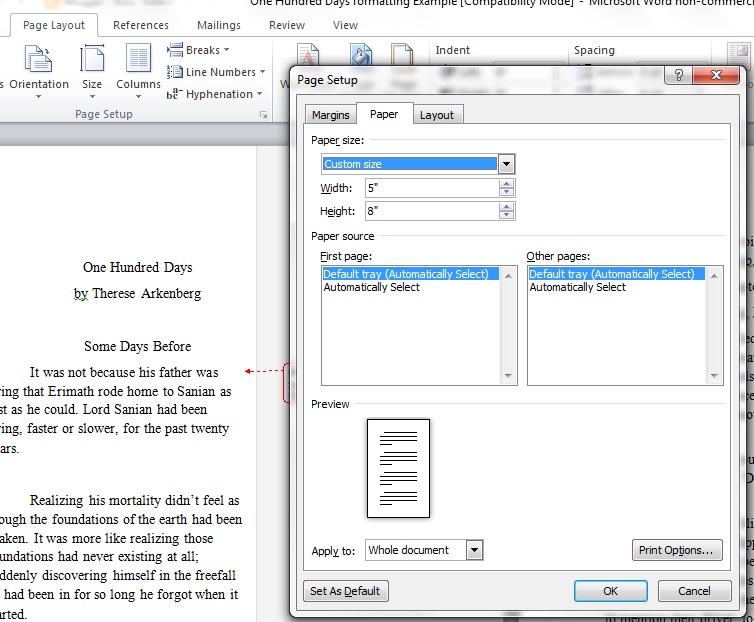
Some people might be willing to print their book in 8.5" x 11", but I am not one of them. I want my book to look like a book--in fact, grasping a model at random off my shelf, I find a nice, solid mass market paperback of 5 by 8 inches. And CreateSpace has an option for books in just that dimension! Excellent!

Under the "Page Layout" tab, just to the right of margin settings in MS Word 2010, you'll find the "Size" option. Select "More Paper Sizes" and set your preferences in the window for custom settings.


Width, five inches, and Height, eight inches, and--

Oh.

My slim 208-page baby is now a whopping opus at 634 pages. I feel like Tad Williams. That's good, though, right? Everybody loves long fantasy novels! Look at George R.R. Martin!

Now, my loyal readers deserve a good price, so I'm going to charge $9.99. Plugging this into the CreateSpace royalty calculator (through the link under the Royalties tab), I see that with each sale I will make:


Negative two and a half bucks for each sale on Amazon (on the bright side, it's just less than negative fifty cents through CreateSpace). Clearly if I'm not going to lose money, I'll have to ask more. $11.99... still negative...$12.99 doesn't do it either...skipping over unlucky number 13, I find a cover price of $14.99 will net me a full 50 cents on Amazon. But I'd have to charge $21.99 to make anything off expanded distribution. This is, remember, is for a mass market-style paperback, the kind that retails at the drugstore for $6.99.

It looks ugly, too:

Here's the first fix, and it's relatively painless: increase the page size from 5x8 to 5.5x8.5. This makes it "trade" paperback sized, while not weirdly large (in fact some trade paperbacks are 6" x 9", and this may be a good option if you really want to slim down). Furthermore, increasing your page size does not affect price. This makes CreateSpace a weird inverse of the offset printing world, where mass market paperbacks are cheaper than trade. If you've got your heart set on a mass market paperback size, you can keep it, just use the other tips here, and realize it'll still come out more expensive than other books of the same size.

By making our pages bigger we've cut the number of them down to 517.
And now, at $9.99 cover price, we're able to make a profit of just under one dollar in the CreateSpace store! But we're still losing a dollar a sale on Amazon.

My next suggestion is to drop the font size. I wrote One Hundred Days in Times New Roman, size 12, which is the easiest for me to read onscreen. Not everyone finds Times New Roman optimal for POD printing, but I suggest you stick with a similar serif font such as Garamond. 12 point font is actually rather large, though, and you're better off dropping it to 11 points or even 10. If you're unsure whether you're going too small, try a 'print test'--format a page, print it out, and see if it's readable. 11 point font is 11 point font; if it's readable on a sheet of printed paper it'll be readable on the page of a printed book.

As an aside, if you want your books marketed as Large Print, they need to be in at least 16 point font. I'd suggest you format a complete separate edition, likely with a higher cover price, if you're really dedicated to ease-of-use for your nearsighted fans (even as this nearsighted fan thanks you).

At 444 pages, you're able to make nearly $2 in royalties through the CreateSpace Store. But still no revenue from Amazon, and the pages still look slightly off:


This is because I wasn't careful when I switched from manuscript formatting to publication formatting. Line spacing is at 1.15, and there are 6 extra points between paragraphs. Although some experts suggest having line spacing slightly greater than 1, there's no need for any extra space between paragraphs, especially given how I'm using first-line indents.

Some experts who want greater-than-one spacing suggest setting a point width exactly, and making it several points greater than the size of your font. If you're confused right now because you don't know what a point is, don't be: I don't know what a point is either, except it's some sort of measurement of the height of letters and/or lines. 12 point font is bigger than 11 point font, and setting spaces of 'exactly' 13 points between rows of 11 point font should give me enough space to satisfy anyone, without leaving unsightly gaps:


This all goes on in the 'paragraph' window, as you can see. Spacing before and after should be zero. Note the "Special" indentation but don't worry about it just yet.

My file for One Hundred Days is now 352 pages long. That's considerably shorter than it started out as, and would net me 92 cents royalty on each Amazon sale. I'm very nearly satisfied.

Some self-publishers are satisfied at this point. But be wary. It's a trap. This is the mistake which drove me to write this post in the first place.


Don't those margins look a little off to you? They're so wide, the text is like a column across the middle of the page. And that pure, snow-white inch on each side--that's wasted space.

You correct margin formatting under "Page Layout".  Select Custom Margins, and then look down at the "Multiple Pages" options. You'll want Mirror Margins, differentiated by "inside" (the spine) and "outside" rather than Left/Right. Because of the book's binding, CreateSpace suggests having at least .75" of inside margins. But this is still a good quarter-inch less than the default one-inch margins give you.  And you certainly don't need, or want, one-inch margins everywhere around the page!


My favored setup is .8" for the inside (I'm cautious), and .5" or less for the top, bottom, and outside. This still gives readers a place to stick their thumbs--the purpose for an outside margin--if not to take notes (I figure they can use post-it notes if it's vital) and allows another inch of text on every page.

Making this change saves me nearly one hundred pages--from 352 to 258. At $9.99, the book now earns $2.05 in each Amazon sale, $4.05 from CreateSpace, and...wait for it...5 cents with each sale through expanded distribution.

Hey, at least it isn't losing money.

Reducing the margins is probably the single best thing you can do to save pages, and it makes your book look much more professional. Another change that should be made for professionalism, even if it doesn't save a lot of space, is adjusting your paragraph indents. That should be the First line indent option under the Paragraph screen--do not indent using tabs!

Instead of the default half-inch indent, which looks really deep and distracting (and even worse if you have wide margins), I would suggest 0.3". You might even try 0.2" for smaller pages or finer-grained fonts, but 3 is a nice round number.

This adjustment is primarily aesthetic, but it drops the page count from 258 to 254--and 4 fewer pages nets me an extra nickle per copy sold, with a royalty of $2.10 at Amazon and a whole $0.10 in expanded distribution. At this point I begin to realize there's not a lot of money in expanded distribution, and that only makes me sadder for writers who don't format in a way that lets them make the best of what they've got.

Now the formatting is mostly complete, but you may make a few more adjustments. Read through your book to see if anything more can be trimmed. Remember, wasted space is wasted money! Consider cutting your transition page and just write 10 years and a Musical Interlude Later above the next chapter. Your dedication will look fine on your copyright page, and you probably don't need 3 introductory pages of reviewer quotes however much the reviewers love you. I wouldn't make a blanket rule against page breaks for new chapters, but do watch around those page breaks, as well as final pages, for any dangling lines or paragraphs. See below:


This isn't bad, but I'm a skinflint and it galls me to see those two measly paragraphs adding an entire page. Watch out not just for dangling paragraphs (less than 4 or 5 lines on a page) but dangling lines at the end of paragraphs, where the last row contains only one or two words. Rephrase your paragraphs to make them more concise and trim those danglers. Even if you're not that worried about pagecount, this can be a good exercise if you're over a maximum number of words for an assignment or to meet submission guidelines. Plus, in a certain state of mind this trimming exercise is quite fun!

If you don't want to cut dangling lines or paragraphs, you can instead expand on them, adding enough vivid and juicy details to make them worth the space.

My final result: 98,00 words in 249 pages.
Royalty for 9.99 paperback:  $2.14 on Amazon, $4.14 in the CreateSpace store, and $0.14 through expanded distribution. I'm not so sure that last will pay off. Of course, a near-100,000 word novel might sell for more than $10, enough to make Expanded Distribution worth it.

As a gift to a friend, I once printed a book of slightly more than 100,000 words in 5.5"x8.5" dimensions, and it came out at 349 pages. This is because there were more chapter breaks, and since I was writing for fun I allowed more "dangling lines," and most crucially, I wasn't thinking and I left the font at 12 pts. But the fact is, based on your preferences your 100,000 page book might indeed come out closer to 350 pages than 250. It wouldn't bring in much at $9.99, but at $12.99--still quite reasonable now that most paperbacks go for $15-$16 at retail--it would bring in $2.74 at Amazon, $5.34 at the eStore, and $0.14 expanded distribution. The sense I'm getting is that expanded distribution is just difficult. But I could create a steep discount code for the CreateSpace store and still make a profit!

One last word of advice for slimmer books: CreateSpace has a fixed price for books 108 pages and lower. This is not the case with Lulu, which has no floor--if you can fit your story onto 60 pages it'll be cheaper than 65 pages, and so on. But if you're with CreateSpace, you won't get any better deal for cramming into 75 pages what would look better in 95. Cramped pages with tiny margins and tiny font are a pain, and look doubly ridiculous if the book itself is slender. Also, books need to be at least 100 pages before you can add a title and author's name onto the spine, because a certain width is needed to provide a margin of error for printing. CreateSpace suggests not adding spine text to books of less than 131 pages, and LighteningSource's minimum is 80 pages. You decide what risk you're comfortable with (I have seen 100-page POD books with perfect spine text). For very thin books, you might also consider printing on "cream" paper, which is a bit thicker than white and may round out a book that would otherwise appear anemic.

To conclude, my inner economist wants to crack a joke about proper formatting being all about the marginal difference--but I won't. Instead, I shall just wish you good luck with your next publishing endeavor, and I beseech you to remember the margins. Your bank account, your readers, and the trees will thank you!

For more tips on formatting for people who are writers, not designers, see my post on Promotional Bookmarks through VistaPrint.  And for more advice on formatting, publishing, and writing in general...well, I've literally written the book on writing, editing, and publishing. And formatted it for CreateSpace, fitting 97,000 words onto an extremely readable 200 pages. Not to brag or anything.

Sunday, September 15, 2013

Story up at Perihelion! "Equations in the Mirror"

My science fiction story "Equations in the Mirror" is up at Perihelion Science Fiction. This is one of the few stories that ever required me to whip out a calculator (another is Ayema's Fleet in the Battlespace Military Science Fiction anthology) and was based on a number of cool medical techniques I'd learned about. Being for a time a Paleolithic history/pre-history fan, I was delighted to learn that obsidian stone blades are still used by surgeons in the modern day. The idea of dark glass and dark reflections tied in with other, more unsettling medical advances in cosmetic surgery.

That math I did involved taking measurements of my own face (actually just one measurement: I think of the length of my lower eyelid) and then extrapolating the other numbers according to the supposed ratios of the Golden Equation as applied to the human face. You may roll your eyes (which are the perfect length, if I may say) or raise your eyebrows (wonderfully proportioned--not to be creepy), but for what it's worth, some cosmetic surgeons do claim their work has a basis in the Golden Ratio. Which is why I was more amused than stung my one of the rejection letters I've preciously received for "Equations," one that said The concept of basing cosmetic surgery on the Golden Ratio just didn't ring true...at all.

Wednesday, August 14, 2013

Anatomy of Successful Crowdfunding (or, How I made 700% of my Kickstarter goal despite a godawful cover image)

What makes a successful crowdfunding project?

Any number of things, I'm sure. That's the good news. A campaign doesn't need to be 100% successful on all fronts to make its funding goal, it just needs to do enough things well enough. But a lot rides on certain key choices you make for your campaign.

In the spirit of inquiry, I've conducted this--is it called a "postmortem" is it's successful beyond my wildest dreams? -No, a friend reminds me the word I'm searching for is "debriefing"--this debriefing, then, of my Kickstarter campaign for The Starter Guide for Professional Writers.

To start with the most important choice: carefully consider the website you select as your crowdfunding platform. For many, including me, this comes down to the perennial question, "Kickstarter or IndieGoGo?"

At first glance, the major difference between the two platforms is that IndieGoGo has a "flexible funding" option, while allows you to keep all funds raised even if the campaign doesn't make its goal. Meanwhile, Kickstater's approach is a more intimidating, high stakes "all-or-nothing" game.

There are more subtle differences as well, such as the nature or end goal of the projects being funded. Kickstarter's focus is narrower: the campaign must fund a specific project created by the campaign runner, and rewards must also be produced by the creator, preferably in conjunction with the creative project fundraising is for. Ongoing programs that are business as usual, without a set end date or outcome, can't receive funding through Kickstarter.

Because of these distinctions, I think my friend Zahara Hecksher is right to suggest IndieGoGo as the better platform for NGO and nonprofit work, but even then not in all cases. Kickstarter campaigns can aim to achieve charitable goals alongside creative ones, and in fact, Zahara and her co-authors' project looks to me like something that would meet Kickstarter's guidelines, if they'd wanted to go that route. A concern is Kickstarter's requirement that projects meet the full funding goal to receive any funding at all. The effort and inconvenience of a crowdfunding campaign falling through for lack of interest is a setback for a creative project, but might spell disaster for a nonprofit many people are relying on.

However, a Kickstarter "all or nothing" funding goal should be the lowest amount needed to get the project done--if the Kickstarter campaign doesn't meet that minimum funding requirement, the project couldn't happen anyway even with the amount it has managed to raise. This presupposes the Kickstarter campaign is the major or even only source of funding the project will get, and certainly can be argued. In contrast, IndieGoGo's Flexible Funding lets the project get all donations, but the campaignrunner pays a higher transaction fee if it fails to meet its goal (and the minimum goal must be at least $500--much higher than a Kickstarter goal is required to be, if Kickstarter in fact has such minimums at all).

A creative and, to my mind at least, reasonable middle ground is practiced by StartSomeGood, a crowdfunding platform specifically for charitable causes.  StartSomeGood campaign runners set a portion of their ultimate goal as a "tipping point." Without reaching the tipping point, the charity couldn't go through with its project. Therefore, if a campaign doesn't raise enough funds to meet the tipping point, no funds are dispersed--so far it's all or nothing. But once the campaign funding reaches its tipping point, it gets to keep all collected donations from there on, even if it doesn't meet its ultimate goal.

Already you can tell the variety of crowdfunding platforms beyond Kickstarter and IndieGoGo: places like StartSomeGood for charitable causes, GoFundMe for more personal fundraising needs (including events, education, and medical expenses), the recently launched platforms Moola-Hoop and NaptimeStartups for women entrepreneurs, and a myriad of sites for Green projects: from  Ioby--"in our back yard"--for local causes to Mosaic and Sunfunder which focus exclusively on investments in solar power.

To choose the right platform for you, things like the mechanics of the site and ease of use are certainly helpful to know, and I'll discuss those in the context of my Kickstarter campaign in a few paragraphs. But the most important question first is: Can this platform attract funders for me?

As a writer, the comparison that comes to mind is booksellers. Say I (or, better yet, my publisher) is trying to find a place to sell my books. We intend to market our butts off to spread the word about them, but ultimately we'll want to put our books somewhere interested readers will come across them even if they never notice our publicity efforts. Sure, some of my fans and all my friends and family will buy my book wherever it's sold, just as your crowdfunding campaign should be able to generate some portion of its funding just through the strength of social connections. But past that point, I certainly hope my book is posted on Amazon!

This doesn't mean ruling out niche funding platforms like Mosaic or Moola-Hoop, though. Because if I'm writing a romance book, I certainly want it on Amazon but I also want it on AllRomanceEbooks. ARE doesn't attract as many readers as Amazon in sheer numbers, but the readers it does attract are far more likely to be interested in my book, because it's a romance and that's what they're there for. Many of the millions browsing Amazon might prefer blood curdling thrillers. Quantity or quality, one way or another your chosen site has to bring in enough people who are interested enough to fund your project.

Of course, generating that interest, once you're in funders' sights, is your job. And so after that introduction on crowdfunding in general, here is my dissection of my actual campaign.

Goal: My goal was to raise enough funds to pay for distribution (including shipping) and formatting costs (including cover art) of my self-published nonfiction book, The Starter Guide for Professional Writers. These things are not extraordinarily expensive, but I am extraordinarily broke and appreciated the chance to have some guaranteed income from the project as I continued with it. Because I was nervous of Kickstarter's all-or-nothing approach, I wanted as modest a goal as possible, and would have done less than $100 if my friend Zahara hadn't encouraged me to try harder. In the end, I made my goal $200--and Zahara "bet" that she'd cover any remaining costs if I didn't reach my goal. Spoiler alert: she never had to pay a cent ; )

Secondary goal: I also hoped my Kickstarter campaign would generate some work for me as a Manuscript Doctor.

Offering reviews of short stories, opening chapters, and novels along with ebook and print copies of the Starter Guide as rewards, I effectively turned my campaign into a "storefront" for my services. This is in contrast to a "patronage" model where my rewards to funders would be more symbolic than substantive (a model I followed with my charitable IndieGoGo campaign to fund microloans at a small Ghanaian NGO). When it comes to a project I'm undertaking for profit, I prefer to offer people value-for-value. However, several funders did feel strongly enough about the work to give much more generously than required for their reward, including one of my personal friends and mentors who gave without choosing any reward at all. Although I'm not comfortable relying purely on a patronage model, I am very grateful for these funders and appreciate what they've helped me accomplish.

(Note: For tax purposes, crowdfunding donations can be considered either income or a nontaxable gift. While not a tax lawyer and not intending to offer any binding advice, I idly muse that the distinction may involve whether the rewards offered to funders are merely symbolic or operate on a "storefront" model.)

Setting up the campaign: I committed a cardinal sin of Kickstarter. I did not have a video for my campaign. This stems from me doing the project entirely on my own, and not being a person with much filmography or video editing talent (or, indeed, any video camera besides my webcam). I didn't have the necessary skills, equipment, or time.

Perhaps I would have done better if I did use a video, but I'm satisfied with the results of this campaign anyway--over 700% satisfied, you might say.

However, even the still image I used as "cover art" for the campaign, while it communicated what I wanted to communicate, was clearly done by a writer and not an artist in my own humble (very humble) opinion:


To reassure you all, one of the expenses my campaign funding will pay for is professional cover art!  The best I can say about this is that it is fairly readable and thematically fitting (several of the books on the shelves, though you can't see it, are my contributor's copies, and the use of Courier font is even meant to reflect the Standard Manuscript Format which most writer's markets require submissions to be in).

But remember what I said about not having to be 100% successful at all things to have a successful campaign! Without much talent at images, and with a project that is based fundamentally on my use of my words, I set about polishing my words as though my life depended on it. Months before launching, I scribbled notes about the campaign in my notebook margins. Then I reshaped those notes into coherent sentences. I typed them up, then reread them onscreen, and then rewrote them. I left the campaign pitch and description of rewards to sit for a few days, then came back and rewrote them once more. And I did a final review as I entered the data into Kickstarter's campaign set-up pages.

Rewards: Given my storefront model, it was very easy for me to tailor my rewards to my prospective audience. There were really only two: the Starter Guide itself and my manuscript critiques.

I offered ebooks at retail value--$5, a early preview deal of the ebook that now retails at $5.99 booksellers like Amazon and iTunes (the final manuscript of the Guide turned out substantially longer than I planned on during the crowdfunding stage). Print copies were $10, which is lower than current retail and includes shipping. Lastly, I offered signed print copies at $15.

My first manuscript critique option, the "First Chapter Review," was listed at $25 and included a free download of the ebook. Kickstarter reports $25 as the most common pledge amount, and it's generally recommended that you have some options less than that, too (like the book copies).

I offered a variety of critiques after that, with funding based on the length of the story, and all including a free copy of the ebook. Here, I've since gained some insight into my audience: critiques could be for short stories, novellas like my own Aqua Vitae, and novelettes (either short novellas or longer short stories depending on who you ask). Nobody took those crits as such. Instead, when they arranged critiques at those levels, what they really wanted was a critique of that number of words. So my novelette critique, meant  for a short story of 16,000 words or so, is actually a critique of a 16,000 word excerpt from a longer story. There was some discussion with another funder about reviewing a short story of 4,000 words as a First Chapter, which we in the end decided against because my approach to whole stories is different from opening chapters (an opening chapter must make me want to keep reading. A complete story must make me glad that I read the entire thing. The second takes more effort to both write and review, though neither is easy).

This is not a complaint. These funders' projects are all exciting and I look forward to working with any portion of them (those I'm not already enjoying working on!). I simply forget, being a big novella fan myself, that many other readers and writers prefer the longer novel form. I might have a complaint about the tendency of new writers to write massive first novels (there's an across the board tendency for stories to be significantly above 100,000 words), but that's for the new writer's sake--extremely long manuscripts from unproven authors have a hard time selling. Editing that extremely long manuscript into something shorter is absolutely doable, of course, and part of what I'm here to help with.

Anyway, between the Starter Guide copies and the manuscript reviews there is a very rough breakdown between "low-level" funding and "Big Ticket" funding. As anticipated, most funders signed on at a modest level, while most overall funding came from Big Ticket items. This is epitomized by the fact that 70% of my funding came from one item, the Hero level Exhaustive Novel Edit. I'd designed this (at $350, though in the end it went for more than that because of the scale of the work the funder and I agreed to undertake) to carry the campaign on its own if need be. It did, although even without it I would have made my $200 goal more than twice over.

Strategy: Crowdfunding campaigns can incorporate some very advanced promotional planning, as in this Sample Promotion Plan from StartSomeGood (in PDF). It pays off. Zahara was part of a team of 7 people who enacted a coordinated plan of media appearances and social media participation--along with more personal outreach, including emails--and raised over $10,000 in 60 days.

I'm an identical twin, and I've been known to refer to my stories' characters as part of my working/writing "team," but last I checked there were not seven of me. My promotional plan amounted to lots of scribbled directions in my notebook and daily planner. My planning efforts went mostly towards deciding how to structure the actual campaign, what rewards to offer, and how to phrase my pitch and FAQs. Past that, my social media approach might best be described as "organic."

I made posts to my blog and Facebook after meeting my goal (which happened while I was in a plane home from Vegas...for a funeral), as I approached stretch goals, and as I neared the close of funding. Some of my updates were shared by friends, and this produced a couple of referrals, but the vast majority of my traffic came from people who found me while browsing Kickstarter. Drive-by traffic--the "crowd" of crowdfunding--was vital to this campaign, delivering at least 18 pledges, including some of my most substantial.

In fact, this is worth digressing on: remember how earlier I encouraged you to decide your crowdfunding platform based on the traffic it attracts? Very little is more frustrating to me, as a creative type, an admirer of entrepreneurship, and a passionate supporter of various causes, than to see a crowdfunding campaign crash and burn because someone overlooked a crucial component. I'm especially frustrated when the platforms themselves are the ones to drop the ball. Why load my book on NotAmazonBookseller dot com when I can sell it out of the trunk of my car at flea markets with the same amount of publicity support?

GoFundMe seems to run on a model where the campaigners attract most of the traffic (I say this as someone who has come to GoFundMe with some frequency, but only by following a fundraiser's referral--I never go just to browse). But it tends to raise money for small-scale, personal causes. In general, I want the platform to be attracting some traffic for me.

I've recently discovered a crowdfunding platform with awesome potential, centered around helping women entrepreneurs (who get a disproportionately tiny amount of investment for their startups). This platform not only does crowdfunding but also wants to offer advice and coaching to the women who build campaigns there. They are so new that they haven't yet put any campaigns up on the site, so I've signed up to receive updates. That's fine. But--

They are so new that their website does not appear on the first page of Google results when I search for them--or more precisely, it does, but the site will not allow Google to display its content among the results. That's currently what happens with my old Livejournal when you search my name--because I don't want you to check out my outdated Livejournal, I want you to be here! Presumably Naptime Startups wants me to be on their website, but they do a poor job directing me there.

The next Google result is their Youtube channel. They have a video explaining what they do--Kickstarter would be proud--but when I, not in the mood for a video, clicked their account profile to find their website link, their "About" section was blank. No link. They give the URL in the last frame of their 2-minute video. It's not clickable. I am lazy and do not wish to type out URLs for the websites I visit. Alas, in this case I had to--because I cared enough to bother. An eager potential funder had to jump through far more hoops than she cared to in order to visit this site. This is especially troubling because this platform has employed experts for the purpose of coaching their entrepreneurs in marketing--and their competitor in crowdfunding for women, Moola-Hoop, is doing social media right. Moola-Hoop's YouTube account links to their website. It also isn't their first result, their website is--and their Google search results include much more detail about their mission and method.

Okay, I'll have mercy on Naptime Startups (after all, I have signed up for updates once they start funding, and I do want them to succeed), and on you. Here's their website link: http://www.naptimestartups.com/.  And the end of my digression, hopefully with my point well made.

Let's look at the origins of my funders, drive-by and otherwise.

Demographics: During the first days of my campaign I was surprised but delighted at the strength of support from the D.C. area. People who found me after browsing projects by location were generous and interested donors--many of the funders who choose manuscript reviews came from within the D.C. Metro area. Is this because DC has an especially strong literary community? Or are my particular funders especially dedicated to supporting their community, including through crowdfunding? Or were they just browsing local listings out of curiosity, and my campaign description caught their eye? I would assume some combination, although it's worth noting that my most generous funders were people who had already made many contributions to Kickstarter campaigns in the past. As my campaign succeeded based on "drive-by traffic" already present on Kickstarter, this doesn't surprise me. I think it stresses the importance of having a well written description and a clear, attractive pitch (including images) to draw in people who won't necessarily be familiar with you.

The same goes for another segment: I received 3 pledges from users browsing the Nonfiction project listings, including my biggest pledge. I'm not certain how many people do or would search Kickstarter specifically for a guidebook for new writers, although I made sure to feature "writers" and "publish" in my pitch and description to make my campaign easy to find. None of Kickstarter's currently trending #tags seemed relevant, but I would certainly check out trending tags before launching a new project in case there was a serendipitous fit.

From social networks, I received 2 pledges from Facebook referrals, 2 through Twitter, and 3 more through other forms of referral traffic, which I think may include the Absolute Write forums where I frequent, and where I linked to my campaign in my signature. These 7 people included some I knew by name, some who I was recommended to by people who knew me by name, and at least one funder who isn't even from the same country. Word of mouth paid off nicely, if not on the staggering scale of some Kickstarter campaigns.

By far the biggest group of funders was my "Last-minute supporters," who appeared in the final 30 hours. Two pledges came in response to Kickstarter's 48-hour email (which reminded people who had starred my project as of interest that it was about to close), and another 10 came from users browsing the Ending Soon list on the site. Anyone with a struggling campaign should find this encouraging. I should note that all of these last minute pledges were at moderate levels, rather than Big Ticket manuscript critiques. But that hardly matters, given these were all complete strangers believing in my project enough to buy into it! These pledges on their own might have been enough to turn the tide if I was only $100 or so from my goal.

An unanswered question is whether people were more willing to pledge because both my goal and my "stretch goal" had already been met--they were jumping aboard an already sure thing, which must appeal to the more risk-adverse crowd. I say this as someone risk-adverse myself. I do know the IndieGoGo campaign launched by Zahara's group met its funding goal near or on the final day, but it was being funded by well over a hundred people and under a flexible funding model; in short, the guarantee was there for them, too.

What helped me the most? Aside from the fact that Kickstarter and my campaign description were producing traffic, what helped the most in converting that traffic into pledges--and substantial pledges--was the messaging system.

Whether or not I would describe myself as approachable (like many writers, I am shy; like many shy people, I am quite friendly once you show gentle interest in me), the fact remains that I am not infrequently approached by people on the various writing forums, websites, and social networks I belong to--seeking advice about writing and publishing, mostly. It's part of why I decided to write the Starter Guide. That said, Kickstarter was no exception. Several funders, including my 2 largest contributors, contacted me first though messages to clarify rewards. In both cases the reward as stated didn't quite fit their needs, so we proposed, counter-proposed, and even haggled a bit until we were each offering something the other was happy to accept. These talks with funders were invaluable in giving me perspective on what my audience wanted and helping them get what they wanted. I also love Kickstarter's robust message system for the way it and the fulfillment surveys help me keep in contact with funders.  IndieGoGo is not nearly so good at collecting contact information, and it doesn't have a site-based message system either--meaning, if you enter the wrong email address as an IndieGoGo funder, the campaign runner might not be able to contact you afterwards (gulp!). With Kickstarter there's no such risk of disappearing through the cracks; my funders and I can find each other anytime we like.

With the help of funders major and moderate, my campaign neared $1,000, and I decided to add a Stretch Goal: something additional I could offer or accomplish with the extra money. My stretch goal reflects the "storefront" nature of my campaign: I went on sale. Basically, with $1,000 I would have enough financial breathing room to "pay myself" and offer my services as a manuscript doctor for 50% off to Kickstarter funders. This hopefully encouraged more people to sign on, and rewarded those who supported me whether or not they had a manuscript to review at the time.

Part of the reason we made our stretch goal as early as we did (it would have been met with those last-minute supporters in any event) was because I started one of the manuscript critiques a bit early. I sent my Hero funder the first few chapters of her story with my comments, we had a 2-hour phone talk about them, and she was happy enough that she upped her pledge by arranging me to review more of her work. Kickstarter recommends you not fulfill any pledges until funding is dispersed, but in this case it paid off. We already trusted each other thanks to our messages and email exchanges. And, with my Kickstarter linking directly to this blog, she knew where I lived.

Since the campaign raised over $1,500 I'm thinking I should add a "stretch goal" after the fact, probably another sort discount to my campaign funders. Perhaps people ordering print books will also get a chance to download the ebook, and those ordering the ebook might get a discount if they decide to buy a print copy.

After the campaign ended, Kickstarter promptly deposited the collected funds in my Amazon Payments account. For the record, I still prefer IndieGoGo's model (and Kickstarter's model for UK and Canadian campaigns) of depositing funds into your bank account rather than using Amazon as a middleman, and I had some frustration with my Payments setup because of an odd looping glitch. But the glitch was cleared up after two or three distraught emails to tech support, and the swift deposit even outweighs the convenience of IndieGoGo's direct payment, which still takes more than a week to process--when I raised money for microloans using IndieGoGo, I had to borrow several hundred dollars from myself in order to have the cash on hand before leaving for Ghana.


Outcomes:
Link: The completed campaign for The Starter Guide for Professional Writers
Links to the published book can be found here
Total funding: $1585
Number of backers: 31
Ebook orders: 15
Print copies (including signed): 10
Manuscript reviews: 5 (each also included a copy of the book, including a signed, dedicated print copy to my Hero funder)

Where do I intend to put that funding? Well, I'm currently negotiating professionally done cover art. I also have some funding set aside to pay for an expanded distribution plan of the print book through CreateSpace*, as well as some reserved for printing and shipping the books as part of Kickstarter pledge fulfillment. Lastly, while I am not a big believer in paid advertising in general, this campaign has produced enough that I may be willing to experiment with ads--I'm currently considering FaceBook and Ralan.com.

*As I worked on this, CreateSpace changed their terms to offer expanded distribution for free. A pleasant surprise!

Lessons learned:
  • Set your goal modestly. Get funded quickly! Stop worrying about all-or-nothing funding! Then move on to your stretch goals!
  • Have some 'guarantees' on hand before launching your campaign. It's just embarrassing to go through all the trouble of setting up a campaign page only to raise $5, especially if it's an "all-or-nothing" site model (yes, I have seen campaigns that only raised $5, particularly on less-trafficked crowdfunding sites). I had my bet with Zahara, whose belief in me paid off. In the end she didn't have to pay up--wise woman!  As my campaign neared the $1,000 stretch goal, but also the end of the funding period, my Hero funder and I had a tacit agreement that she would step up with the rest of the funds if no one else did. I stress, though, that the latter case wasn't a "bet" but rather a fortuitous arrangement--we'd already agreed that I would take on another of her stories provided we both liked each other's work. And we did. 
Lessons not yet learned:
In a job interview recently, I brought up my crowdfunding experience and my interviewer asked me what one thing I wished I could achieve better results at. The consistent challenge, for me--let's leave video production aside--is generating word of mouth without becoming obnoxious to my followers (or fans, or supporters, or whatever the term for my audience may be in a given forum). With a few exceptions, I haven't managed to create a project or project description enticing enough to get people shouting about it from the rooftops. Perhaps it's a secret sauce. Perhaps there is no secret sauce. Figuring that "Ask not and you shall never receive," I even closed at least one update with an explicit (hopefully polite) call to action for funders to spread the word about the project, but without much result. Perhaps none of us had friends that would be interested in a writer's how-to guide? Writing can, after all, be a lonely job...yet on the other hand writers tend to congregate together.

The real reason I want to know how to generate word of mouth is because I'd like to achieve a rapid growth in scale--after all, doesn't everyone on Kickstarter want our campaign to be the next Choose-Your-Own-Adventure-Hamlet? As an aside, one of my friends funded that campaign and she's shared some choice quotes from the book ("To Be or Not To Be: That Is the Adventure") with me--it is wonderful and hilarious! And look, Ryan North just generated another instance of word of mouth advertising...

Additional Outcomes:
As I hoped, this Kickstarter generated several leads for manuscript critique jobs. Not only have I established a track record of pleased clients, but my campaign description also lead to someone contacting me after the funding period was over to ask about a query review.

Lastly, doing this campaign has given me more solid experience in crowdfunding, not to mention a wealth of numbers to crunch. Some of this information is going back into the Starter Guide (which after all wouldn't be complete without a section on crowdfunding for self-published books!), and some is being shared in reports like this one.

~*~

I hope this proves useful. Feel free to comment with further questions, your own observations, thought experiments, or perhaps a defense of Naptime Startups' social media approach (they're new, of course, and may even have fixed the problem by the time this post goes live. For their sake I do hope so). You may also point out my hypocrisy in bemoaning new authors' overlong manuscripts while producing a blog post of multiple thousands of words.

Friday, July 26, 2013

Reward in Daily Science Fiction's Kickstarter! Also, Newsletters.

Daily Science Fiction is hosting a Kickstarter Campaign to pay authors for their short fiction published for the next six months, September 2013-March 2014.

Among rewards including omnibus anthologies, gourmet chocolate, and a crocheted Cthulhu, you can also sign up for a critique from Yours Truly of a short story (they say up to 5,000 words, but I wouldn't complain about longer, either)! See the details for Daily Science Fiction's Fall 2013 campaign here.

On the topic of Kickstarter campaigns and critiques, the campaign for the Starter Guide for Professional Writers has breezed past its original goal--made it more than 4x over, in fact--and is just $130 shy of the Stretch Goal. If the campaign raises $1,000, I'll have enough financial leeway to offer a half-off deal on any manuscript critiques to all my Kickstarter funders. There's a little less than a week yet to get it on that.

A last piece of news: if you check out my 'Contact' page on the right sidebar, you'll now see an embedded MailChimp form allowing you to sign up for email alerts on the publication of my short stories, books, or just life in general.

Plans for the weekend: Well, I've spent the past week touring subleases in DC, and there are one or two I really like and am following up on. Fingers crossed! And then it's on to the job search in August and September!

Wednesday, June 26, 2013

Blogging from the Writer's Staycation

After my work with Zahara proved so rewarding last semester, I've continued as her assistant over this summer. This means I've been able to attend not only one but two Staycations--and this time as an apprentice Fellow, which means this Friday I'll be an opening and lunchtime speaker.

It also means that, with four weekdays dedicated to my own projects, I finally have time to ressurect some of the old draft posts for this blog.

So what is the Staycation, exactly? SomeECards explains:
Photo

Except instead of cupcakes we have healthy snacks (and some carefully guarded chocolate covered raisins for emergencies), and the internet access was spotty on the first day because of router and bandwith issues. Which made this Monday one of the most productive of my summer.

The idea is that writers who aren't able to swing a Writer's Retreat in the Rockies by a cristalline mouantian lake may find it easier to take some time away from 10-5 every day for a week, and get all the productivity, sociality, and some of the treats at much less cost. Personally I have never appreciated 'me' time so much, to say nothing of the treats and, indeed, the social side of things. It's especially great when I can meet up with people who write in my favorite genres. And writers can spark off each other. The other day another writer overheard me talked with my sister about how "Something has to change or I'll be killing her off, too". The callous extermination my character inspired this fellow writer to look at her own cast, and lead to the erasure from existance of one of the protagonist's multiple siblings. My (late, but not forgotten) character would be proud to leave such a legacy of destruction.

This week I've done some polishing on short stories, but my major efforts are going towards The Starter Guide for Professional Writers and One Hundred Days. I'm not moving linearly through either of them, but I'm finishing about a chapter a day plus scattered paragraphs and margin notes. While the substance of the Starter Guide is mostly there, it needs much more organization than I at first realized, and while taking with other Staycation writers and learning their questions and advice I've found even more content to add. I expect to have the final version complete soon!

Friday, June 7, 2013

Print Books that are *Good* for the Planet

Being surrounded by the printed word (and intending to remain so my entire life--much as I enjoy ebooks, I like to keep paper copies for backup), I remain acutely conscious that it's called "dead tree"s for a reason. Also, ever since my trip to Ghana I've had a horror of plastic. It's bad enough seeing litter at the side of the road in the US, but I saw bags and discarded packaging piling up in places I never would have expected--water canals, forest, even the borders of cemeteries--and on a staggering scale. The thing is, Americans produce far more of the stuff than Ghana does, we just cram ours in landfills where it can't be seen...for now...

So I was ecstatic to discover it is possible with current technology to make books out of recycled plastic. I know of only one book made this way so far--Cradle to Cradle by Michael Braungart--by I live in hope that the method may catch on. 

Simon and Schuster also has a series of children's books printed on recycled materials.

I'm disappointed that the only recycled books I can find so far are explicitly on environmental topics. The innovation runs the risk of remaining inbred, while I think if it works it should be used where it counts--in all genres, fiction and nonfiction. Especially since plastic books, being waterproof, can be read in the bathtub. And I don't know about you, but I'm much more likely to read sweet romances or can't-put-it-down thrillers in the bathtub than proposals for environmental policy, however well-presented.

Friday, May 31, 2013

Blogging from the Home Office

It's very nice to have a room of one's own, even if that room is really just 185 square feet serving as bedroom, office, and kitchen all at once. I'm not sure how productive I've been, but I feel productive because I'm sitting down at the computer at least once an hour to type, revise, or research something. In between I'm reading (but sparingly--I don't meet the residency requirement for a library card and I don't have much cash for buying new books, so the ones I've got have to last!) and just today, performing a grocery run and culinary experiments. After wo-manhandling a minifridge into my room. I'm glad they delivered it the door, but I'd have been happy to let strangers into my room just to get it three feet farther...

Part of what I've been working on is The Starter Guide for Professional Writers, which I hope to have out before the end of June. The IndieGoGo campaign for pre-orders and publication expenses has two weeks left to run, and to as a last prompt I'm offering a complete line-by-line manuscript critique as a perk. A few people have expressed interest, so you might want to check that out before it's gone.

Going by people's choices of perks, I may expand to offering opening chapter reviews as a service beyond this campaign, since it's a swifter and more affordable way to determine your novel's all-important first impression. If I make line-by-line critiques of novels (above and beyond developmental edits) a regular thing, though, I'm afraid I'll have to increase the fee for it, because intensive line by lines take a lot of time and effort. So the IndieGoGo perk may be your only chance, or at the very least the most inexpensive.

Sunday, May 26, 2013

WisCon 37--A Partial Review

I was certain I wouldn't make it to WisCon this year, coming as it did right before my moving trip to Washington, D.C. But with some last-minute crunch and a willingness to run around disoriented (I've learned these will get you far in life, or at least lead me very far afield), I made it for at least the weekend and Friday evening.

Friday:
After hurriedly packing for DC, I stuffed my backpack with my immediate needs for one weekend and set out to brave the Memorial Day weekend traffic. And then Madison's one-way streets. This harrowing experience concluded in time for me to make it to dinner with my sister and some lovely strangers she met on the Internet. Between weekend festivities and the convention, every restaurant in central Madison was packed. Still, the 45 minutes before harried waitresses brought our food gave us time to go through our pocket pamphlets and circle likely-looking panels. This process is one of anticipation mixed with frustration--there's always 2 or 3 different panels going on at the same time that I want to see. And there's a limit to how much running around disoriented even I can do.

The first after-dinner panel we attended was "Cyborg Identities," a discussion of Donna Haraway's theory that cyborgs transcend science fiction and have potential for feminism and social theory--given the omnipresence of technology and constructed reality means that we are all cyborgs. I'm paraphrasing from what I gathered, as I haven't actually read Haraway (Megan, the grad student, made our panel decision there ;D). Still, it left me with some take-away thoughts on how reality is constructed--"there's no such thing as nature," if nature means a state where humans do not alter our environment through our interactions with it--and a glimmer of understanding about polyrythms as the panel was lead in an impromptu performance by panelist Andrea Hairston. I am not particularly good at managing even a monorythm, but it was interesting to know more complex patterns are possible.

We dropped by the QUILTBAG TARDIS party, but turned in early after a long day. Megan wanted to prepare for her reading and to be a panelist on Saturday, and I saw a morning panel that looked appealing.


Saturday
Woke up bright and early, hoping I could get lunch before the panel on 'Digital Death' that I dearly wanted to attend. I was in luck, as right outside the hotel doors I discovered a farmer's market, including multiple booths selling bakery items. Cinnamon raisin bagels provided me with nourishment to face the next few panels.

Digital death: Worrying about the privacy of your online information while you're alive is bad enough, but what do you do when you die? Who inherits your ebooks? How technologically savvy does your digital executor need to be? Are you better off just waiting for a grad student of the future to crack the encryption on your hard drive (much joking about what that student may find there--including disappointment that it's only 2D), or perhaps creating a "dead man's switch" to automatically revert your password to 'password1234' when you, presumably dead, fail to log in after a year? Takeaways to remember: Katherine Mankiller's story of the parents of a friend whose discovered, upon that friend's untimely death, the slash fanfiction on her LiveJournal (they made peace with that side of her, prompting the slogan "We love our dead slash-writing daughter!"); the importance of periodically reviewing your will and any listing you have of active accounts and passwords; the impact of changes in format ("Plain text is your friend," and maybe pdf if it's kept simple), and "loooove your data". Also sue people if you really want to do a favor to your future family genealogists; it's a great way to get your information recorded and preserved.

Women in Power: This one seemed to fly by far too quickly, before the panelists could really sink their teeth into issues like "what is our working definition of power?" and "Do we recognize power when it's coming from someone other than the recognized head of a community or association?" We did learn about a number of remarkable historical and modern women, from Wu Zetian (first female emperor of China) to a modern Chinese scientist who single-handedly fought an AIDS epidemic in her province. Also discussed was the importance of media attention, documentation, and the use of awards and public recognition to turn the personal power of an individual into the communal power of a movement.

I met up with Megan after the morning panels to grab lunch in the con suite (the sweet onion relish, which must come from a local Wisconsin farmer or his/her grandmother, is to die for; and for some reason all the LonCon fortune cookies we opened recommended stores by Iain M. Banks) and explored the dealers room and art show. Despite being too broke to buy much of anything--except a copy of Dr. Who Magazine with Paul McGann on the cover, modeling the Eighth Doctor's new black leather peacoat look--I made grabby hands and high-pitched yearning noises at books, jewelry, paintings, felt creatures, and a miniature clay figurine of Jon Snow and his white wolf puppy. I haven't even read the books or watched Game of Thrones.

Editing for Writers--this after-lunch panel was packed, probably to the joy of panelists who remarked "There is not enough good editing going on." Being almost obsessive in my pursuit of melodious prose, I can only agree. However, the main problems are less stylistic than failures of clarity--or, as one panelist put it, "Is this clear? And is this funny to anybody but you?". Thus the importance of beta readers and professional editors, and the importance of listening to and communicating with your editor. However, the main flaw of beginning editors (and betas!) is tactlessness--being too blunt about the failures of a text. Sadly, I can testify to the truth of that myself (I and my friends have gotten way better since the first meeting of our high school writing club). Another observation true in my experience is that many new writers develop bad habits as a result of lax schooling--basically, teachers are so happy to find students who enjoy writing and have a grasp of grammar and structure that they never push us to try better. But again, that's what editors are for.

I attended this panel for more than one reason, given my freelance editing jobs. It was not exactly encouraging to hear one woman ask for advice on becoming an editor only to be pressed to keep writing instead--"You can make it rich writing!" Then again, these are also editorial positions that include wading through slush piles, which I have only heard horror stories about. Panelists did mention that developmental edits can be particularly useful for writers who have what they feel is a solid manuscript which keeps getting rejections for no reason they can discern. Developmental edits and copy edits are both essential for authors considering self-publishing--otherwise, the publisher will supply a copy edit. Sometimes a copy edit from Hell where all the flavorful local dialect your characters utter is corrected, but that's why communication is important! Personally, I think it's also appropriate to hire an editor when you have a manuscript which needs attention that beta readers can't give it (either because you can't find a beta in your genre, or want something more in-depth than most volunteers can offer) before being submitted for publication.

It's Actually Quite Hard to Rip a Bodice Part 2: The panel on historical accuracy in fiction was as much of a riot as it was last year! Refreshingly, there was a greater range of panelists this year--guest of honor Jo Walton said her method of research was less directed than "suddenly writes something and realizes random recreational reading of the past decade was leading up to it", which sounds more my style than "50% background research before story, 10% during, 40% after" because with my luck the 40% after will be what proves everything I wrote could not possibly have happened (in this world, at least). I'm more likely to look at real-world historical research for inspiration than to let it tell me what I can or can't do (*stops foot like petulant teenager, shakes fist at History*). All the same, I'm perfectly happy to hear what people who do research exhaustively write and discover. Discoveries include things as weird as the "Swiss army knives" carried by the Roman legions, and the fact that ancient Greeks and others told the future by examining the liver because they believe the liver is the seat of the mind. "Because it's triangular," Walton assured us. This somehow led to her wondering whether they ever told the future by the placenta (apparently you have to have seen one to get this; I have not and will take it on faith). They never did, so she can write that original idea into a story sometime...the payoff for intensive research, I guess.
Oh, and they've tried ripping bodices. From what I remember from the panel last year, bodices are sewn together in a way that resists tearing quite remarkably. Sorry.

Help, Gender Essentialism Is Everywhere!: I attended this panel on how writers can avoid gender essentialism to give support to my first-time panelist sister, missing out on a discussion of Large House vs Small Press vs Self-Publishing and, perhaps even more distressing, "Realistic and Unrealistic Sex in Fiction."
I jest.
Well, a little.
I did attend to provide moral support, but this was an intensely interesting panel that I would gladly have attended anyway (even to the point of missing out the other two? Well, that's what the internet's for! By which I mean the Absolute Write Water Cooler forum has plenty of discussion of publishing options--what did you think I meant?). The panelists discussed their own efforts to include sexualities outside the gender binary, what methods were successful, and what happens when reviewers get confused. Luckily, there seems to be a healthy number of short fiction markets that are enthusiastic about representing non-binary identities, though this may be more difficult in longer works with New York houses--none of us are exactly sure. My question about managing and countering stereotypes for characters who lie on multiple identities prompted one of my favorite quotes of the convention, from Keffy R.M. Kehrli: "Be careful when playing at intersections; you may get hit by a truck!" By which he meant not that it isn't worth doing, just that it needs to be done sensitively and with care. The air of the panel was overall encouraging: representing non-binary and/or trans* characters isn't to be done lightly, but it's also done far too rarely and many editors and readers are eager and supportive of writers willing to try.

After grabbing dinner (and an ARC of Sam Sykes' The Skybound Sea, which I was literally unable to put down--I tried, but blasphemous monstrosities were rising from the ocean and the prose sang in my ears), Megan and I grabbed seats somewhat in view of the stage for the Tiptree Auction. Last year we were on the far side of the ballroom, but really, wherever you're sitting the auction is as good or better than a night with the stand up comedian of your choice. From the opening bids on a paperback copy of the 1971 classic The Feminists--our sacred text went for almost $50; not bad considering I think the cover said 35 cents--to an Alice Sheldon pillow, decorated rocket ship tiles, original Lynda Berry illustrations, more pulp paperbacks featuring buxom 'hoydens' and sheer pastel spacesuits (I'd have bid on A Woman in Space but it was already over $30, which given my budget seemed a bit much even for such a juicy morsel), a Space Babe engraved hip flask, a robot-decorated bag featuring the damn cutest baby robot ever, and the shirt off Ellen Klages' back. Also an Ellen Klages doll, which I'm sure we never knew we needed before. And a bottle of Lysol, which I'm sure was never ever never needed for its advertised purpose. Why we need feminism, indeed (well, that and in order to round up all the men for breeding chattel. I read it in a paperback, it must be true).

We popped out of the auction long enough to see Lauren Jankowski read from her first novel, Sere from the Green, at the Broad Universe reading, but then we came back because we were having just too much fun. We left once the auction started winding down.

Sunday
No farmer's market, but I did have to jog across the Madison Memorial Day Marathon to get to the Concourse. Not quite certain what to do, I stood on the curb and applauded runners approaching the finish line until I saw a clear space.

Another early morning panel for me, this one on "Intimate vs Remote Gods". Panelists ran the gamut from a Lutheran minister to a content atheist, so lots of interesting discussion made it worthwhile. Also one of the panelists recommended C.S. Friedman's Coldfire Trilogy, and I savor the proof that I am not the only human being to read and enjoy it (logically the fansites and fanfiction suggest I'm not, but I never run into fellow fans in-person). I also need to check out the Dark Faith anthologies, which kept providing intriguing examples.

Race and Class in Urban Planning--though the topic has some applicability to science fiction and fantasy, this panel was mostly about real life: school closures in Chicago, "affordable housing" in San Francisco, gentrification everywhere and enough hipster artists and "urban pioneers" to make you want to call pest control. By which I mean hipster urban pioneers were discussed; if any actually attended the panel they kept it well hidden (wisely). Audible dismay passed through the room when we learned that classrooms in Chicago public schools are considered "underutilized" if they contain less than 32 students. My parochial school class was treated as unmanageable in the second grade for having 31 kids. Which wasn't inaccurate. Developers still only pay lip service to consulting communities before going ahead with projects that can destroy neighborhoods--except when they run into committed citizens ("granny power" as one panelist described what happens when the retired and unemployed in a community go to work lobbying for its interests) who can command media attention. This is the sort of fascinating conflict that should be appearing more in fiction.

Megan and I compared notes and realized we each technically meet the threshold for the Mid-Career Writers lunch roundtable: we've both been publishing short fiction since 2008 or earlier. In any event, we didn't get thrown out. New writers have a lot of resources to draw on, which is great, but what happens for the rest of your professional life? A group of eight or nine of us introduced ourselves, described what was going on and particular challenges faced at this point in our careers, and brainstormed solutions. This is the sort of meeting I'd like to attend more often, although still being on the very new end of the mid-career I spent most of the time listening.

My last event of the day was the Outer Alliance Reading, with Megan along with 6 other writers reading excerpts, short stories, and poetry. I don't usually read Megan's fiction for some reason, maybe lack of time or the feeling that I'll be asked to beta for her again one day (I don't think I'm afraid of being influenced by her; our styles have gone in very different directions), but ohh boy, I had goosebumps at her reading. Other stories were more lighthearted. Especially fun were Cliff Winnig's "The Call of the Sky" (in When the Hero Comes Home 2), with clone families and ensuing identity crises that were just complicated enough to be refreshing rather than confusing, and Sunny Moraine's snappy, elderly seer confronting the wastrel playboy of her space-nomadic tribe in Line and Orbit. In my post on using bookmarks for promotion I mentioned that they are useful more as a reference for individual readers than as a sales tool, but Moraine made good use of them for both--I grabbed one after her reading convinced me her story is something I'd really enjoy.

I drove home after the OA reading, to finish packing and get some rest before setting out tomorrow. This is my last blog post from Wisconsin in who knows how long. At least you can be a fantasy fan & writer from anywhere!