Monday, August 10, 2015

"The Grace of Turning Back" at Beneath Ceaseless Skies

"The Grace of Turning Back," the final story of the Curse-Strewn World sequence, appears in Beneath Ceaseless Skies Issue #179, which can be read on the BCS website or in the Kindle store.

The Tynesi merchants, who traded everything from the silver rice of Timru and perfume leaves from Simrandu to chips of ivory off the Keld’s temples, had a term for a particular sort of improvidence: to throw money, time, or strength into seeing to completion a bargain they had already got the worse end of. It’s all After-Bad, they’d say.
A useful phrase. Aniver vaguely remembered his clearheaded pleasure at first learning it.
That pleasure blossoming within his soul had been sacrificed to fuel a magelight to chase away Semira’s nightmares as they approached the edge of the world. It hadn’t meant much to him, had not made up more than a candlelight’s worth of his being, but Aniver was down to the dregs of his power now. And he was draining those dregs, perhaps After-Bad, but he didn’t think they would do much good where he was going.
Has Aniver thrown so much of himself away After-Bad that he has nothing left for his last great spell, returning Nurathaipolis and her sister cities to their proper place in time? At what cost? Can Semira help him without losing herself, too?

You'll have to read to find out, but I will say writing the ending of this one had me tearing up more than once. Maybe because I'm sentimental, maybe because the Palisades Library (where my friend got me in Tuesday evenings for weekly writing parties) was very dry, who can say?

Also, [slight spoiler follows] for those of you curious to see how a Grace with six wings might look, this gorgeous piece by Rebecca Yanovska might help provide an idea. I didn't see it until I was into the editing process, but when I did I had that feeling of recognition.

I'm very grateful to Scott Andrews at Beneath Ceaseless Skies for publishing the Curse-Strewn World stories, and of course to all of you for reading along with them!

While "The Grace of Turning Back" brings Aniver and Semira's stories to a conclusion, it isn't necessarily the last we'll ever see of them. Two prequel pieces are in my drafts notebook--"The Queen of Yesterday," referenced in "The Storms in Arisbat," has an interesting tale to tell, and of course there's the story of how Aniver and Semira met in the first place on The Glass-Clear Sea.

I can't promise I'll be able to smuggle a secondary-world version of the Sunk Cost Fallacy into those, but I'll surely have fun trying.


Friday, May 8, 2015

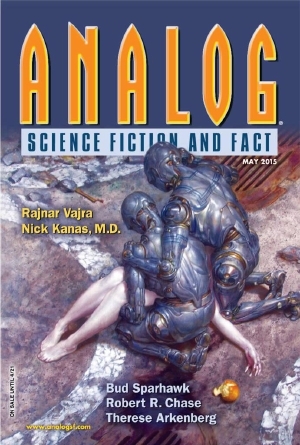
"Arnheim's World" in Analog Magazine

In the May 2015 issue of Analog Science Fiction and Fact, alongside fiction from Rajnar Vajra, But Sparhawk, Robert R. Chase, Aubry Kae Anderson, and J.L. Forrest, my story "Arnheim's World" explores the economics, ethics, and (anti)sociability of terraforming.


Environment, economics, ethics, all stewing in a high-tension dilemma. Exactly the kind of thing you'd expect of me, I hope. 

I worked on this piece on and off from 2011 onward, intrigued by the idea of a person wealthy enough and motivated enough to shape a planet in their own image. The plot changed direction several times as I incorporated new concepts and found myself drawn towards one character's argument or another's as they addressed the central conflict. A lot of my science fiction stories deal with dilemma, and until I find a resolution that satisfies me they can sit unfinished for a long time. Mind, just because I pronounce myself satisfied with a story's ending doesn't mean I think any one character made the right decision--just that I sympathize with them all and find the outcome of events pleasingly...twisty. Or twisted. Sometimes I write an ending I find myself hoping readers will argue with (I still remember reading along with TV Tropes, trying to find loopholes to 'fix' "The Cold Equations"). 

For "Anheim's World," I think the conflict that most preoccupied me is less about economics than about friendship and betrayal--and times when betraying a friend may be the nobler decision.

You be the judge. 


Tuesday, February 24, 2015

Common edits to improve your writing

A lot of editing and rewriting involves relatively minor mechanical and technical changes. A lot. Not that I'm complaining; making these simple changes is a routine part of my work, and if nothing else it keeps me steadily employed. Many of them are changes I make to my own writing on a second draft!

However, I thought it'd be helpful to share my "greatest hits": the advice I give most often, and make use of most often when revising my own work. If you can apply this advice to your own manuscript, it will become noticeably cleaner. This doesn't mean it'll be perfect--but once a story is polished technically, it can be easier to spot and address more subtle or individual strengths and weaknesses. If a manuscript is full of run-on sentences, it can be hard to even follow the plot, much less worry about how it meshes with the character arcs!

  • Which brings me to my first bit of advice, and the one tidbit of information that has been most useful to me personally this past year: the average sentence should be about 20 words long. Some will be shorter. Others will be much longer. You'll want to manage longer sentences carefully (especially if they're over 30 words), and you probably won't want to use more than one or two per paragraph. The first sentence in this bullet point is 35 words long; the third is 27. 
  • Check to make sure that a long sentence isn't in fact a run-on or a comma splice. I don't think you need to be a grammar expert to be a good storyteller. However, being able to write clear sentences is important to allow readers to follow along. Also, being able to spot and fix run-on sentences (as well as to avoid writing many of them in the first place) will save you immense amounts of time on your second draft--and, if you hire an editor, a manuscript with fewer sentence boundary errors to correct will save you money, too. 
  • When it comes to sentence boundary errors and sentence structure issues, such as parallel structure, I encourage all writers to approach them humbly. Overconfidence about my ability to write a clean sentence meant that I've taken a long time to acknowledge and fix several of my most awkward habits. I'm still catching myself using poetic comma splices or abandoning parallel structure without good reason. I suspect I'm not alone in my overconfidence, either, because sentence boundary errors are the single issue with manuscripts that I spend the most time fixing. 
  • One method to catch run-on sentences, which also is an excellent method to study your word choice and voice in general, is to read the story aloud. Listen to the places you pause--for effect or for breath--and try to make them match the punctuation on the page. Raise your voice when you write a question mark (which should only go after a direct question). Only take a breath at periods/full stops (and shorter breaths at semicolons, shorter still at commas). Learning to read aloud was an important part of my own long education in the fact that, hey, I really do write too many long sentences! 
  • The English language is not like German--it's likely that far fewer nouns need to be capitalized than you might think. That is, I more often have to put nouns in lowercase than I do capitalizing them in the manuscripts I edit. Some of these excess capitals may be hypercorrection (the same thing that causes people to say 'whom' instead of 'who' in the wrong sentence, or to say 'I feel badly' rather than 'I feel bad'). I believe you can trust your gut here. Unless a word would look distressingly wrong without the capitalization, it’s probably just fine in lowercase. 
  • However, if you don't trust your gut, here's a handy rule of thumb: a noun is capitalized if it names a unique item (the Thames river, the Story Addict blog) or is being used as part of a name (I thanked my doctor by saying "I'll never be able to repay you, Doctor Barnes"; I told my mother, "Good morning, Mom"). If not, then probably not. Note that 'Mom' is capitalized when it's addressing the mother, but lowercase otherwise. I was excited to hear Aunt Janie was coming for a visit. -vs - Her aunt, Janie, came to visit that weekend.  
  • Dialogue can appear clunky when it's always tagged in the same way. By this, I don't mean to encourage using "said-bookisms"-- "said" is a clear and invisible word. However, every line of dialogue does not need to be prefaced by "Character Name Said." That makes a manuscript look like a screenplay. Also, consider using a variety of dialogue tags--sometimes "Character name said" and sometimes "said Character Name" (odd as it sounds, I've read manuscripts that only used the latter form, and it invariably began to sound awkward). Sometimes action beats instead. The variety will keep a conversation lively and interesting to follow. However, dialogue tags that are awkward, unnecessary, or repetitive can distract a reader so much that it ruins the entire scene. 
  • Be careful of the phrase "and said". Often this is superfluous--readers will assume that the character who performs an action beat is also the speaker within the same paragraph (on which note, remember to start a new paragraph each time there's a new actor or speaker). Occasionally, adding "and said" will produce a sentence that overstays its welcome in an anticlimax--She felt her world crashing down around her, leaving behind only a hollow emptiness, a chilly void like she'd never felt before, and said, "I'm so unhappy."
  • In general, "and" sometimes links information within a sentence that doesn't need to be linked (a made-up example I enjoy sharing is She was crying on the stairway all night and she had never liked getting takeout, anyway.
  • Speaking of connecting information and avoiding anticlimax or bathos: details of character action, emotion, dialogue, and inner monologue should be carefully chosen to contribute to a particular mood and communicate specific ideas. Be careful of language that might be distracting or carry connotations you don't intend. Synonyms rarely mean the exact same thing. 
  • I always highlight repeated words in manuscripts. It's a good idea to avoid repeating the same word within a brief amount of space unless it is necessary to make a point or communicate clearly. Depending on how unique a word sounds, and thus how memorable or noticeable it is, I suggest avoiding an echo of it within the same sentence (always), within two adjacent sentences (usually), within a single paragraph, or even within a full page or entire chapter. Likewise avoid repeating the same figure of speech. 
  • Some of the most common verbs I find myself highlighting are turning/turned, looking/looked, walking/walked, and smiling/smiled. Some writers attack the problem of characters turning, looking, walking, and smiling too much by using synonyms, which is good for word variety but may still lead to characters behaving in eerily repetitive ways. Consider cutting some instances of these words and synonyms, but also consider when different word choice would be stronger. She looked at her mother angrily could become She glared at her mother. Likewise, She walked towards him could be She approached him or She stalked towards him depending on the nature of the scene. And lastly, these verbs can be unnecessary within context. Characters can be assumed to have turned to the person they're addressing (if they haven't, this is worth mentioning), to have looked at an object the narrative in their point of view is describing, or to have walked to the room they come into. 
  • A weird fact: 'blond/e' is one of very few English words that is gendered. Men are never blonde, they are blond
  • Dialogue is considered part of the same sentence as the dialogue tag.  “She said” is not a complete sentence. It should be connected to the line of dialogue by a comma. Capitalize appropriately. This one is worth stressing, being perhaps the second most common error I correct, and common among manuscripts that are otherwise very polished. 
  • I have a personal preference for showing only dialogue in quotation marks, and putting all other communication (such as written text the characters are reading) in italics. There isn’t complete consensus on this, though. All the same, I suggest avoiding reader confusion by never using quotation marks for a character's unspoken inner monologue. Instead, use italics (I thought, this story is harder to understand than I expected. I muttered to myself, "I could write a blog post about this."). The risk here is making it look like your character has just called his boss an unprintable word aloud, and readers will wonder why he isn't being fired.
  • Passive voice is to be avoided except for when there is a specific reason in favor of using it. Aside from being verbose, passive voice obscures the identity of whoever is performing the action, adding an unnecessary air of mystery (except for when the writer uses passive voice to build an air of mystery very deliberately). Passive voice can also blur the line between action and description--was the ladder set against the wall when they entered the room, or is the protagonist leaning it there right now?
  • Filters such as I thought, I felt, I heard, and I remembered are often unnecessary, and can be cut unless they contribute to clarity or sentence rhythm. 
  • It's common advice to "show" rather than "tell," but it's important to focus on "showing" the most important details (it is the storyteller's privilege and duty to decide what details are most important to the story). Use "telling" to communicate information that needs to be known to make sense of the story, but isn't dramatic or significant enough for showing. If a detail doesn't really add to the story, you don't need to mention it at all unless you want to. 
  • Melodrama is a matter of personal taste. In general, though, I believe most manuscripts benefit from making use of subtly and having extreme and intense moments stand out because of their rarity. If every character screams their dialogue in every scene, it becomes harder to tell when a disagreement is really serious. If a character bursts into tears over failing to find a parking space, it'll be a struggle to show how much worse the character feels when Aunt Janie goes missing. 
  • Once information is shown or told, it won't need to be introduced again, although it may be referred to as the character has cause to remember it. Outlining can help you keep track of when you introduced specific information, and that will keep you from repetition that leaves the reader thinking "Yes, I know already, get on with it!" Rereading will also help catch this. 
  • Nobody wants to think they have unwarranted tense changes in their first draft--but it's quite likely that you do. I almost always do, because I write my outlines in present tense and most of my fiction in the past tense. Sometimes when an author gets caught up in the moment, they switch into present tense. And authors who intend to write an entire story in present tense will sometimes slip up and use past. Luckily, this is usually quite simple to fix; just be aware that this happens so you aren't caught unprepared. 
  • Always look up the spelling of brand names, trademarks, and websites. They tend to be idiosyncratic. Also, once you've looked them up, ignore Autocorrect when it tries to tell you differently. 
  • Speaking of looking up spelling, the Merriam-Webster dictionary is free online, and can be very useful to check spelling and to make sure a word means exactly what you're using it for. Bookmark it.
  • Merriam-Webster will sometimes give you multiple ways to spell a word, especially when it comes to hyphenated ones (although as a quick rule of thumb, adjectives are often hyphenated when nouns are not. He's a blue-eyed boy with blue eyes.) Once you decide on a preferred spelling, you may want to make a note of it on a 'style sheet.' This is also a good way to keep track of formatting decisions (such as whether you spell out numbers or use digits--fiction writing leans towards spelling out most numbers under 1,000--and whether or not you're using the serial/Oxford comma). Copyeditors make style sheets for each manuscript they're working with. They don't have to be fancy. A Post-It note over your laptop that reads "always use hyphen when M-W.com says so; spell one-nine hundred ninety nine and write 1,000<; no Oxford comma; A.M. and P.M." does the job as well. 
  • Metaphors are an area of great risk and great reward. Some people don't think in analogies at all, while others live in a parallel world populated by associations. I'm in the latter group myself, and I enjoy rich, poetic metaphors that build a story thematically and use language in fun ways. However, be careful of cliches, and do make sure your metaphors fit the tone and setting of the story (“The death of Romeo set Juliet on an emotional roller coaster.”) 
  • And lastly, a piece of advice for being edited: it will take time, but be sure to look over each change as you accept it. I always try to protect the voice of each writer, but sometimes I'll rewrite a sentence to offer an example. Or I'll suggest several different changes, and the author can pick the one that fits their story best. Perhaps I'll suggest something that absolutely clashes with the story's goals, and the author will have to click the "Reject Change" button. That said, editors do try hard to make a story the best it can be, and we don't make our suggestions lightly. If you're rejecting every change an editor suggests, consider why that is. Possibly your styles don't mix--but it's not a sign of disparagement for your original authorial voice to correct run-on sentences or suggest you double check the spelling of a word. Be an active partner in polishing your story, and you, your editor, and your readers will be better off from it. 
  • A lot of what I learned about writing I learned from being edited. I also learned a lot about writing by helping to edit others' work (both in critique groups and even now, as a professional editor). I learned several things about writing by carefully reading others' stories, both published and unpublished. And I learned a lot about writing from, well, writing! Never let pass an opportunity to learn. Reading, writing, and rewriting will also help you think more about stories and give you inspiration for your next work. 

Thursday, January 22, 2015

"For Lost Time" up at Beneath Ceaseless Skies

Lose no time in going to check out the latest installment in Across the Curse-Strewn World, a short story sequence following the wizard Aniver and his friend Semira's quest to rescue his home city, which has somehow become lost in time.

Their discoveries in the terrifying library of Arisbat have pointed Aniver and Semira in the right direction, but what a direction it is--the source of the blight that struck Nurathaipolis appears to have come from the Kingdom of the Dead. Aniver's reckless plan requires that he scout out the territory first...

"For Lost Time" appears in Beneath Ceaseless Skies Issue #165, and can be read on the BCS website or on Kindle.

Saturday, January 10, 2015

Free-to-use, high quality photography for ebook covers and more

It's been a busy start to the new year, which I appreciate but means that blogging has taken a backseat to writing, editing, etc. When I get really busy, I often find that lists are a simple way to keep me in the blogging groove. 
Writers, especially self-published writers, often need to find excellent images for their covers and websites--but on a budget. Luckily, the Internet (and some stunningly talented artists!) provides. Here are 8 websites offering images that are public domain, Creative Commons licensed, or otherwise suitable for personal and commercial uses. For free.

[One of my favorite images from Spiltshire)

Unsplash releases 10 stunning images every 10 days under a Creative Commons “Do whatever you want” license. They also take submissions of photography, if you’d like to provide your own images.

Little Visuals does something similar, releasing blocks of 7 images every week.

The Library of Congress has searchable image collections on its website.

Gratisography is the work of artist and designer Ryan McGuire, who offers his surreal and dreamlike images free of copyright restrictions.

Splitshire offers free stock photos for personal and commercial use, including images of food, people, and landscapes.

The WeFunction design blog offers some free high-resolution photos of locations, textures, and whatever else the volunteer amateur (but talented!) photographer wants to snap.

Picjumbo offers free stock images in several categories.

You can search Flickr for Creative Commons licensed images—be sure that the boxes are checked for commercial use and modification permissions if you intend to publish edited images or make money off your use of them.
Some of these sites require attribution, some do not. I suggest you always err on the side of attributing, both to give credit the artist and to spread the word about the image resource!

Monday, November 24, 2014

Living With Imposter Syndrome--Guest Post Live on Fictionvale!

The first mercy of impostor syndrome, in my experience at least, is that it isn’t constant. Instead it attacks at intervals, at moments of either my deepest despair or highest success.
Of course success attracts this psychological beastie’s attention: in the grips of impostor syndrome, my jerky brain is happy to dismiss any achievement as a fluke or a fraud. I’ve either tricked people into thinking I can write, or they’ve reviewed my manuscript favorably from pity for someone so pathetically incompetent. “Despite external evidence of…competence,” Wikipedia explains, I have been “unable to internalize [my] accomplishments.” Sure, I’ve managed to pass myself off as a writer—somehow—so far—but sooner or later, I know my luck will run out. I’m just one bad review away from dying of exposure.
You might think almost a hundred short fiction publications would serve as some reassurance that I’m either not a fraud, or I’m so successful at defrauding dozens of intelligent fiction editors that this con might as well be my calling. And sooner or later, I do decide that I might have something going for me after all. If not talent, still more elbow grease than sheer luck.
The problem is that nothing will ever make me officially, unquestionably a writer. There’s no shiny medal handed down by an omniscient judge. I majored in philosophy, not fiction, and I know enough MFAs who continue struggling with writer’s block to prove that’s no silver bullet, either. Nor is getting published—no short story, chapbook, or novel can scratch my deep-seated itch of inadequacy. Even if this work goes off well enough, what about my next story?
One thing’s for sure, when I’m in the grips of impostor syndrome I don’t dare slack on that next story. And here’s its second mercy: worrying that your ‘fraud’ will be discovered may inspire you to be a better writer.
read the rest at: http://fictionvale.com/living-with-impostor-syndrome/ 

Tuesday, November 4, 2014

All the Grammar Knowledge You Need for NaNo

National Novel Writing Month is not the time to become a grammar expert. The entire idea of this challenge is to stop worrying and write, that is, to churn out 1600+ words of prose each day, prose whose main glory is that it exists, not that it is perfect. Stopping to study capitalizing, punctuation, and sentence structure can only be a distraction, and probably a dispiriting one.

That said, NaNoWriMo is also not a great time to be slowed down by worrying whether you've punctuated this sentence correctly, or indeed any sentence correctly. Picking up the Chicago Manual of Style will slow you down, but so will thinking that perhaps this entire novel will have to be trunked because you've used participles so abysmally throughout that it's not worth the time it would take to fix each page, paragraph, and sentence.

I'm running on the assumption that I'm not the only author who's been slowed down by such worries. From clients I've worked with and friends I've consulted, I don't think I'm the only author to have been slowed down by such worries. And the thing is, these concerns can be addressed pretty simply--all you need to do is learn a handful of general rules. They won't make your first drafts perfect, but they will spare you the time it takes to second-guess yourself or correct common errors after the fact.

Here are seven grammar tips that are easy to learn, that will make your manuscript look that much cleaner, and--once you've memorized them--will be seven fewer challenges to trip you up, slow you down, or worry you as you continue your adventures as a high-speed novelist.

1. The Serial/Oxford comma
What it is: the comma after down in the line "trip you up, slow you down, or worry you." The punctuation makes it clear that slowing you down and worrying you are two separate things. This can be especially useful if you're trying to distinguish among, say, your parents, Ayn Rand, and God. Or worse. 

Some style guides--the one that comes most readily to mind is the Associated Press style guide, the "journalist's bible"--prefer not to use a comma before the last item in a series except when required for clarity (and even then, you might get headlines like the one linked above). To anyone who has had that one darn comma add an entire line to their paragraph, this makes a certain sense. From the newspapers' point of view, they save on space, not to mention paper and ink, by removing that one character. In fiction, ink and space are not such pressing concerns, and the added clarity of the comma usually makes it worth including.

Whether you use the serial comma or not, some people may complain and many others will not mind; just try to be consistent for duration of the manuscript. It may be useful to make a note to yourself or even to create a 'style sheet' to keep open in another tab (or on a notepad next to your computer) so you don't need to pause and hem and haw each time you list three or more things. And while you're at it, list your stylistic choices on the following matters, too.

2. The Em Dash
You can make an em-dash in MS Word by hitting the hyphen key twice: --. Although Blogger doesn't autoformat them the way MS Word does, you can see I've kept the habit.
If you hit the hyphen key once, you get a hyphen, which is a perfectly useful mark but not the same thing as an em-dash. In all styles except AP, the em dash touches the words on either side of it--like so.

Em-dashes convey a casual, lively tone. They can be used in place of parentheses, commas, or even colons, making they wonderfully versatile. In fact, they're virtually impossible to use wrong, which is why I'm surprised more authors don't use them--and why I overuse them myself.

They shouldn't be used for more than one purpose in the same sentence. You can't set off a parenthetical with an interruption inside it all using em-dashes. Break out those commas, parentheses, and (semi?)colons. Still, don't sweat overuse of em-dashes on your first draft, because it's easy enough to fix them the second time around. In practice, em-dashes can indicate parts of the first draft that need more organizational attention anyway. Not all parentheticals are relevant enough to keep, for instance, and sometimes you shouldn't change the topic quite so quickly (or you should change it much sooner).

It's also simple, but time-consuming, to add a second hyphen and remove the space around the half-formed dashes you typed before you knew how to create an em-dash. You can do that in December. For now, go and enter spaces no more.

3. Dangling Modifiers and the Sentence Boundary Errors
A picky editor or agent might reject you for punctuating dialogue incorrectly. A terribly picky editor might reject you for being inconsistent with your italics. Still, neither of those errors are deadly to the reader. Even I--hardly an easy-to-please judge of prose--have gone merrily along with a story full of badly punctuated dialogue because the words themselves, and the characters saying them, and the plot they moved through were all so convincing and gripping.

The truly fatal error, one that will turn off most readers and virtually all editors, is failing to construct complete and functional sentences. Sentence boundary errors don't only make you look illiterate, they make the reader feel illiterate for trying and failing to follow what you're saying.

After penning a sentence, many writers hurry on without checking to ensure it actually says what they mean it to. This is fine on occasion, if you keep your sentences simple and your topics consistent. But a manuscript full of dangling modifiers and run-on sentences could require extensive revision just to make your meaning clear, never mind reaching the heights of eloquence. And that's assuming you don't get lost just writing it.

After penning a sentence, many manuscripts require extensive revision.

Wait, what? NaNoWriMo would be a lot easier if my manuscript would just pen its own sentences.

This is the dreaded (though not enough dreaded, alas) dangling modifier. "After penning a sentence," the modifier, does not apply to the manuscripts but rather to something or someone who is not present in the actual sentence. Specifically, the writer.

I'm uncertain if dangling modifiers are caused by too much faith that the reader will grasp the writer's meaning anyway, or not enough faith in the logic of the English language. That's not to say the English language is ultimately logical or consistent in any meaningful way--we shake down other languages in dark alleys for spare adverbs, for crying out loud--but it is logical enough that modifying clauses don't need to, and shouldn't, dangle. There is always room in the sentence for the noun they're modifying, usually directly after the comma that follows the modifier.

Though complete lack of faith is unjustified, faith may not be wholly out of place. Context will often enough make it clear that it's not your manuscript penning its own sentences. That doesn't make it okay, though. If you don't know any better, it's only a matter of time before you write a dangling modifier that really does confuse the meaning of your sentence (or at the least prompts a ridiculous mental image to those who read it literally, as many people do. Nobody plans to encounter dangling modifiers). If you know better, penning dangling modifiers is just intellectually lazy.

Participle clauses in general are tricky beasts. Another bothersome sentence structure occurs when "Penning each sentence, she left the manuscript to languish." This creates a wibbly-wobbly time warp effect where the pen-wielder is both actively writing her manuscript and leaving it to languish at the same time. I'm not sure if there's a proper term for this bugbear--for my part, I only know it as the Turkey City Lexicon's Not Simultaneous, and my editing clients know it as a margin comment reading "Simultaneous issue" or just "Simul."  

And lastly, there's "After penning a sentence, the manuscript was left to languish in obscurity because, hearing a voice out in the street, she dropped the laptop, running to the door and taking the stairs three at a time."

Whatever revision this sentence is given, it has to involve more periods. One sentence simply doesn't have room for that much action, or that many participles. It makes sense that a lot of newer or first-draft novelists write these kinds of sentences, since a certain amount of tunnel vision occurs in the midst of any creative endeavor. And it's certainly possible to correct these run-ons after the fact, but it may prove easier in the end to simply avoid writing them in the first place. Be conscious of the words flowing from your fingertips. As soon as you type a period, let your eyes scan the preceding sentence. Don't worry about it being perfect, but it may be a good habit to stop and revise particularly confusing passages. If you don't want to do this once a sentence, once a paragraph works equally well (I stop every three hundred words or so to correct misspellings and obviously unworkable sentence structure).

Even if it feels like a drag to slow down and ensure your sentences are functional, I think letting mistakes lie will always come back to bite you later. You'll either languish in editorial purgatory or never get that far in the first place. The good news is that once you learn to spot dangling modifiers, simultaneous issues, and run-on sentences, you'll commit them more and more rarely.

There are some other deadly errors in a manuscript (pacing and characterization are arguably more important, although they're harder to spot on just one page), but once you get most of your sentences mostly right, writing becomes much, much easier.

4. Grammar in Dialogue
As I've said, I'll still understand your story even if your dialogue is punctuated abysmally. I may enjoy reading your story a lot. But I guarantee you won't enjoy going over 50,000 words and correcting every line of dialogue, so it pays to figure out the general rules for it.

"It's that simple," she said.

"She" is lowercase--"she said" is not a complete sentence on its own. Indeed, it's a mere dialogue tag. A comma connects the dialogue tag to the spoken dialogue. The comma goes inside the quotation marks, as most punctuation does (the exceptions are mostly arcane, but can occur when the quotation mark isn't actually part of the dialogue: Did your brother really tell you, "Go to hell"?).

Later on in this post, you'll see I've written the sentence And then my beloved cousin told her, "Should I say hi to your relatives while I'm down there?" 

Put aside for the moment the fact that I started a sentence with "and." That capitalized A may annoy purists, but the capitalized S in the middle of this sentence might look downright terrifying. Still, it has a rationale: Should I say hi ... begins a complete sentence. "He told her" forms the lead-in to the quote: the dialogue tag. They're connected, as you see, by a comma.

Dialogue tags consist of the speaker and the word "said" and its synonyms, although I suggest you stick with "said" for the most part. If you want, you can add modifying clauses (After penning another sentence, she said, "What do you think of participles?"). You don't need to be allergic to the occasional "exclaimed," "remarked," "observed," "whispered," cried out," and "added," as these can contribute contextual information such as tone of voice. Do be cautious of tagging all lines of dialogue this way, though, as it gets distracting, and be wary of explaining the dialogue with tags ("You stole my money!" she accused).

Also be careful of tagging dialogue with words that don't mean "to say"--you cannot smile, laugh, or nod dialogue. These verbs form their own separate sentences. (After penning another sentence, she smiled to herself. "Now what do you think of that?")

5. Quotation Marks, Italics, Boldface, CAPSLOCK
Font choices best used sparingly but to great effect.

Aside from setting off dialogue, quotation marks may be used as "scare quotes" to imply the word choice isn't yours (She told my beloved cousin that he would "burn in the deepest subbasement of hell" for breaking curfew). They come in handy, but overusing scare quotes can get annoying fast, as they have a certain salty, sarcastic flavor. Don't make your readers feel like they're being clobbered over the head with your cutting wit--trust them to pick up the dissonance between words and meaning even if it's represented more subtly.

Single quote marks are used to set off quotations within dialogue ("And then my beloved cousin told her, 'Should I say hi to your relatives while I'm down there?' I'm so proud of his quick wit!" --And if I wanted to set "hi" off, it would indeed be with another pair of double quotes). Outside the US, these are sometimes used for setting off dialogue, and the double marks get used to set off nesting quotes. The thought of such a topsy-turvey world gives me illicit chills, although pretty much everyone will understand "these quotes," too. If you're split, I suggest using the double quotes. Because the single quote mark is also used for apostrophes, if you decide after the fact that you want double quotes you'll have to change every line of dialogue separately lest a universal Find-Replace will produce gems like you"ll. Changing double quotes to single quotes is a lot simpler. When in doubt, go with the one that's easiest to undo.

Italics are used for emphasis, to set off foreign words, and to show a character's internal monologue directly. (She thought of what an idiot she had been. I'm such an idiot). I strongly recommend against using quotation marks to set off your character's inner monologue, or they will give the appearance of speaking their thoughts out loud. If your character is psychic and communicating telepathically, italics are an intuitive choice to depict this, and context should make it clear that they're in dialogue with another telepath. (No, you aren't, he reassured her.)

Unless you are knowingly and deliberately performing an experiment in prose, I recommend leaving the bold tool aside for now. You will just distract readers who are wondering what you mean by the bold text. There are other tools, like italics, to use for emphasis.

WRITING IN CAPSLOCK gives an impression less of emphasis than of volume--an important consideration some authors seem to have overlooked. This makes them look varying degrees of belligerent and/or sugar high. The best use of CAPSLOCK is when a character is shouting louder than a mere exclamation point would suggest. Speaking of which, do not use multiple exclamation points to communicate volume, emphasis, or excitement. Once a reader sees one sentence punctuated like this, a great deal of trust in the writer is lost, as it's only a matter of time before some other courtesy of language is disregarded in favor of what the writer felt like doing instead!!!

Like exclamation points, scare quotes, and even italics, a little bit of CAPSLOCK goes a long way. If upon reflection you'd like to have less volume in your manuscript, you can remove capslock by highlighting the capitalized text and pressing SHIFT + F3.


6. Ellipses
These dots can be used to signify either an actual ellipsis--that is, leaving something out--or a suspension, hesitation, or interruption (although you may find the em-dash conveys an interruption more intuitively, as people being interrupted rarely have time for the brief but distinct silence an ellipsis conveys). They're easy to overuse, and you may find after the fact that they aren't all necessary, but don't let that slow you down on the first draft. They're also very easy to find and fix.

In both Chicago and AP style, a space is used before and after the ellipsis. Chicago style also includes a space between each period of the ellipsis, although MS Word may autoformat and take that out of your hands.

If the ellipsis comes at the end of a sentence, you include a period with it, for a total of 4 dots.

7. Tense and Point of View
As with everything else, you'll want to be consistent--sticking to a single POV and tense within a single scene or section. If you decide to write with omniscient POV or "head-hop," it's your novel--but for the sake of your readers, I strongly advise at least remaining within the same POV for each paragraph. It's not so much because I want to harsh on your omniscient party as that inner monologue, like dialogue, needs organization so we know who's speaking, and paragraphs are meant to provide that.

Some authors mix present and past tense artfully in their stories; others find themselves shifting their verb endings because they're carried away in the excitement of their narrative. It doesn't make you a bad writer by any means, although it can be annoying to go back and correct afterwards. When you're not sure what your next line will be, it sometimes helps to review the previous few pages to see where your scene is going--and while you do this, you also have an opportunity to make sure everything's remained in the same tense and/or POV.

But don't sweat this too much. If you catch yourself changing POV midscene, and you don't want to, but you also don't want to slow down to rewrite it, just make a note to yourself either inline or via a margin comment. Scene started in Martha's POV, now Jim's. You can decide to give the scene to Martha or Jim, or to split it between them both, sometime in March.

8. Spelling & Word Choice
Don't sweat this. You'll survive fumbling accept/except, or even you're/your--provided you know to correct it afterwards. MS Word's spellcheck is helpful, though not 100% accurate.

Yet be reassured: resources are available to check your meaning, if your peace of mind requires confirmation that you've picked the right word and have written it with the right letters. Keep Merriam-Webster open in another tab. Highlighting a word and right-clicking will also summon up MS Word's thesaurus, which can at least suggest if you're on the right trail of meaning.

9. Lay/Laid
Now I lay me down to sleep as I lie down on the bed.
I lay there for some hours, then gave up and reached for the manuscript which I had laid on the nightstand before tucking myself in. I might as well keep editing while I felt up to it.

You lay an object down: yourself, your manuscript, your glasses. You lie down. Your manuscript should not lie down of its own accord.

Image courtesy of Grammar Girl

While you're keeping Merriam-Webster open in one tab, open another for Grammar Girl, who's got you covered. I keep her post on lie/lay bookmarked for added reassurance.